
News
Keeping Thanksgiving Sweet: MSU's MAFES Pontotoc Experiment Station receives USDA grant to strengthen sweet potato research
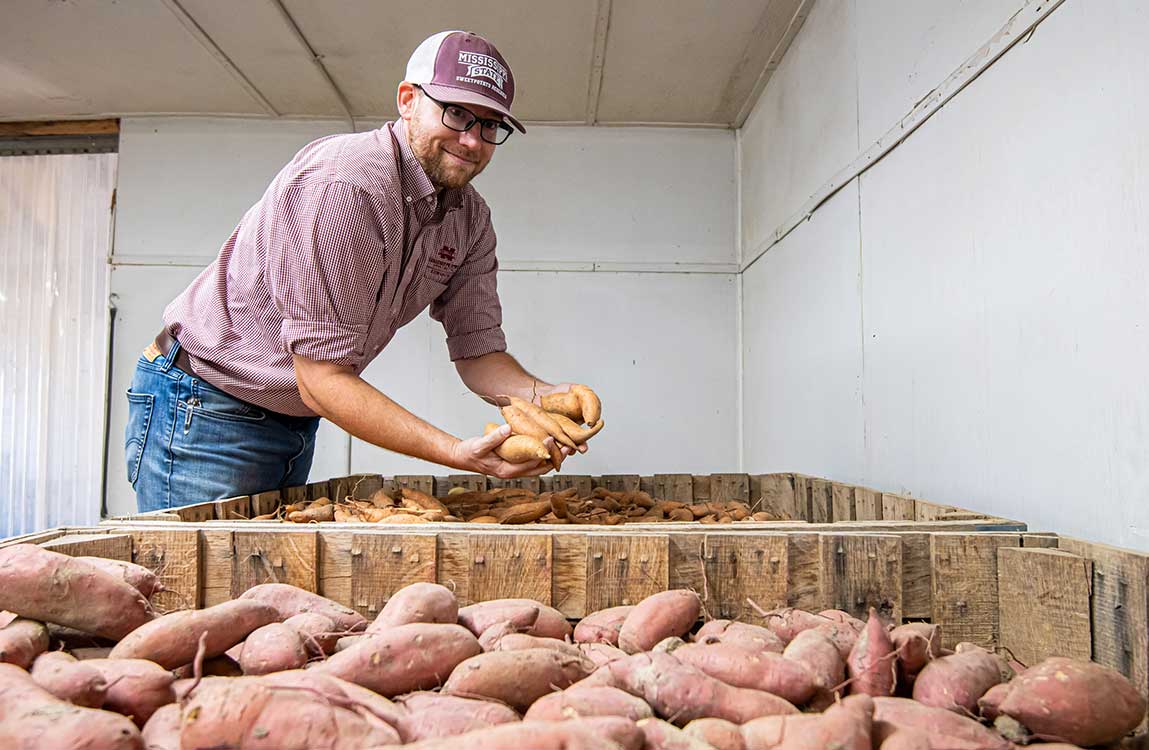
Lorin Harvey, a Mississippi State plant and soil sciences assistant professor, Mississippi Agricultural and Forestry Experiment Station scientist and MSU Extension Service sweet potato specialist, sorts sweet potatoes in storage. (Photo By: David Ammon)
11/19/2026
By: Vanessa Beeson
Sweet potato casserole is a Thanksgiving essential, and quality sweet potatoes in the Southeast begin with clean seed from Mississippi State University. Home to one of six sweet potato clean seed centers nationwide, MSU now is strengthening its support for the popular vegetable's growers through facility upgrades that advance research and improve crop quality.
A $250,000 grant from the U.S. Department of Agriculture's National Institute of Food and Agriculture and funds from the Mississippi Agricultural and Forestry Experiment Station will help MSU enhance research facilities at its Pontotoc Ridge-Flatwoods Branch in support of producers in the state and across the Southeast.
The funding will support electrical upgrades to this MAFES location's primary office and laboratory, installation of a much-needed backup generator and replacement of two greenhouses. The improvements will increase research capacity, improve efficiency and protect valuable plant materials essential to sweet potato farmers and MSU research programs.
Lorin Harvey, MSU Extension sweet potato specialist and MAFES scientist, said the improvements address vulnerabilities exposed during last winter's ice storm, when the station lost power for seven days.
"This ice storm proved the importance of always having a backup generator online for our sweet potato program," Harvey said. "It took us all rallying as a team and someone staying at the station around the clock until power was restored to save the tissue culture."
The station produces virus-free sweet potato tissue cultures and slips for farmers across the Southeast as part of the National Clean Plant Network for Sweetpotatoes. Preserving these materials requires specialized climate-controlled growth chambers and freezers operating at temperatures as low as minus 80 degrees Celsius, making reliable backup power a necessity.
The new greenhouses will feature supplemental lighting, improved drainage and automatic shade cloths to better regulate temperatures throughout the year.
"Our goal is to increase capacity and efficiency," said Harvey, who also is an assistant professor in MSU's Department of Plant and Soil Sciences.
The improvements, expected to be completed within two years, complement construction of a new sweet potato storage facility at the branch. Funded by the USDA, MAFES and the Land, Water and Timber Resources Board, the storage facility will expand the station's ability to support research throughout the sweet potato production cycle.
Together, the projects advance Harvey's vision of making the Pontotoc station a comprehensive resource for producers.
"Since I started in this position six years ago, I've said we strive to be a one-stop shop for sweet potatoes, highlighting research from the beginning of the growing process until the end," Harvey said. "The lab and greenhouses represent the beginning, and the storage facility represents the end. Stronger facilities further position us as experts who can help our growers at each phase of the growing process."
View More News