
Innovation on the Menu
Experimental Seafood Processing Laboratory, Pascagoula
By: Meg Henderson
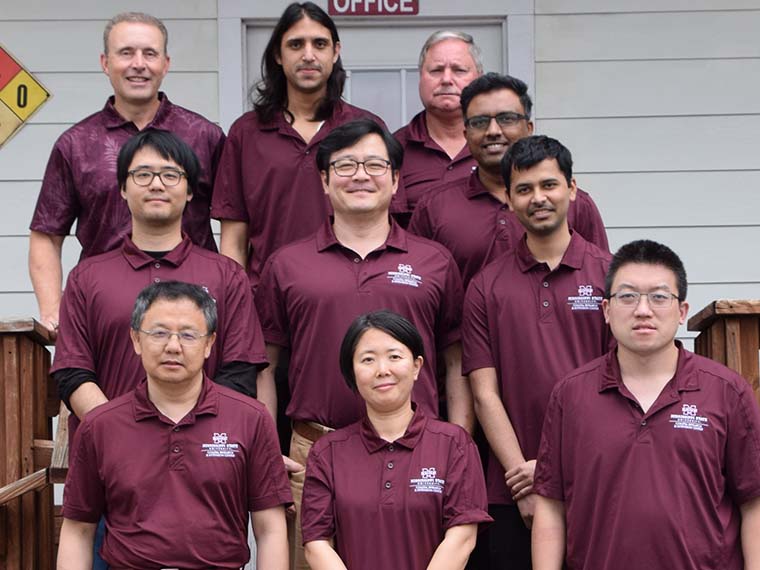
Left to right: top row: Dr. James Henderson, Saad Aqerrout, Jesse Raley; third row: Dr. Jerish Janahar; second row: Yi Jing, Dr. Benny Park, Kumar Bapat; bottom row: Dr. Yan Zhang, Dr. Lin Bi, Dr. Wenbo Liu (Photo by Meg Henderson)
Home to shipbuilding titan Ingalls and a major Chevron refinery and birthplace of legendary singer-songwriter Jimmy Buffett, Pascagoula contains multitudes. This part-industrial town, part-breezy coastal village, surrounded by marsh and marine life as diverse and vibrant as the community itself, is a place where tradition meets technology.
With seafood traditions tracing back to the Native American Pascagoula tribe harvesting from these same waters, the namesake town is an optimal location for the Experimental Seafood Processing Laboratory, operated by the Mississippi Agricultural and Forestry Experiment Station, or MAFES.
"Our work brings together university researchers, government agencies, and private industry partners to address challenges facing the seafood sector. A big part of what we do through our research is help aquatic food businesses remain competitive," said Dr. James Henderson, professor and head of Mississippi State University's Coastal Research and Extension Center.
Henderson grew up in Louisiana, where he enjoyed spending time on the water. He graduated from Louisiana Tech with his bachelor's in forestry; from MSU with dual master's degrees in forestry and business administration; and from Louisiana State University with his Ph.D. in agricultural economics. Moving into his current role on the Mississippi Gulf Coast was a natural fit for Henderson, with his background in natural resources and business.
Dr. Wenbo Liu, an assistant professor in MSU's Department of Agricultural and Biological Engineering, applies his mechanical engineering expertise to automate food production and processing. Originally from Tianjin, China, he earned his bachelor's degree in mechanical engineering from Taiyuan University of Technology and master's and doctoral degrees in mechanical engineering from New Jersey-based Stevens Institute of Technology. Liu was previously a postdoctoral research associate at Pennsylvania State University, conducting research in 3D printing and creating high-tech silicone and thermoplastic manufacturing parts.
With $2.6 million in grants, he designs automated solutions for seafood processing, including a catfish fillet singulation system. He is also working on recycling catfish bone waste for sustainable bio-composite manufacturing, and developing machine learning-assisted multi-3D printing processes.
"I have always been interested in how machines, materials, and manufacturing systems work together to solve real-world problems," Liu said. "Mechanical engineering combines creativity, mathematics, and practical problem-solving, which allows me to develop technologies that can improve efficiency, sustainability, and quality of life."
Liu's team of graduate assistants are all biosystems engineering doctoral students. Saad Aqerrout, from Morocco, earned his master's in mechanical engineering from Mississippi State. Kumar Bapat, from India, received his master's from Northwestern University in data analytics engineering, and holds two patents in India. Yi Jing, from China, graduated from Stevens Institute of Technology with his computer science bachelor's and master's degrees.
Dr. Yan Zhang, a research scientist, leads an aquatics and food science research program. Originally from Shijiazhuang City, China, Zhang has a food engineering bachelor's degree from Ocean University of China, a master's degree in food science from North Dakota State University, and a Ph.D. in food science, nutrition, and health promotion from MSU.
At the lab for eight years and with MSU for 14, Zhang explores ways to increase sustainability and economic opportunity in the catfish industry by developing value-added products from processing waste.
Zhang's team devised a novel protein extraction method from catfish byproducts to increase protein recovery and improve the profitability of the catfish industry. Collaborating with Dr. Keun Seok Seo from MSU's College of Veterinary Medicine, they produced a hydrolysate from recycled catfish skin to potentially treat type 2 diabetes.
"I went into food science because I want to make our food supply healthy and safe," he said. "At the lab, I enjoy making new discoveries and solving problems for the seafood industry."
Dr. Lin Bi, a laboratory technician from Changchun, China, developed a love of science and cooking from an early age. With a Ph.D. in food science from Purdue University, she was a food scientist at Lallemand-USA Yeast Company in Hattiesburg before joining MSU in 2023. Bi is part of Zhang's team, and studies preservation treatments for maximizing catfish quality and shelf life.
"What I like most about my job is being able to directly help local seafood businesses deliver fresher products and reduce losses, which keeps people employed and local seafood available," she said.
Dr. Benny Park, a senior research associate with the lab six years and MSU 12, grew up in Busan, South Korea and earned his bachelor's, master's, and doctoral degrees in veterinary medicine from Gyeongsang National University. He specializes in aquatic animal diseases, developing aquatic vaccines and diagnostics for pathogen detection, and holds six patents.
Currently, Park is studying a species most people see as a problem&,dash;jellyfish—as a solution to mitigating melanosis, a condition marked by harmless but unappealing black spots on shrimp shells that can develop hours after harvest. In Park's tests, freshly caught shrimp stored together with cannonball and moon jellyfish exhibited reduced melanosis.
"I enjoy the process of scientifically evaluating materials and proving their functional roles through rigorous research, and the seafood lab provides many opportunities to do that," he said.
Dr. Jerish Janahar, a postdoctoral associate from the small village of Vellalanvilai in southern India, grew up in an agricultural family. His upbringing and childhood hobby of repairing machinery led him to pursue an education combining his interests. He completed his bachelor's in food processing technology and master's in food processing engineering and taught courses in the College of Food and Dairy Technology at Tamil Nadu Veterinary and Animal Sciences University. He joined MSU after earning a Ph.D. in Food Science and Technology from The Ohio State University in 2024.
His expertise includes next-generation processes and technologies to produce safe, clean-label, and sustainable foods. Currently, he investigates ultrasound-assisted treatments to increase the extraction yield and quality of collagen from catfish by-products, ultimately boosting the profitability for the aquatic food industry.
"The most exciting part of my work is asking research questions and visualizing the answers through data," he said. "Since so many seafood products and by-products are still unexplored, my work can contribute to the industry in so many ways, which inspires me."
Jesse Raley, a Pascagoula, Mississippi, native and building maintenance technician, assists with lab equipment for research projects. He brings 40 years of experience in the seafood industry. Before joining the lab in 2018, he owned a seafood wholesale/retail dockside business and worked as a deckhand and shrimp boat captain.
"I enjoy working here because I grew up in the Gulf Coast seafood industry, and I'm good at organizing and problem solving, along with repairing things," he said.
In 2025, Mississippi State and Jackson County broke ground on the Northern Gulf Aquatic Food Research Center. Projected to open in 2026-27, the new MAFES unit will significantly expand MSU's ability to support the state's seafood industry through advanced research, food safety testing, and product development. Mississippi seafood processors and producers send samples to a lab several states away for critical food safety analyses, delaying results and slowing product movement from harvest to market.
This facility will provide local, rapid testing for pathogens and contaminants, helping strengthen consumer confidence in the safety of Mississippi seafood products.
Beyond food safety, the center will also expand research on extending shelf life, improving product quality, recovering more usable meat from seafood products, and developing new value-added uses for Mississippi seafood and aquaculture products.
Naming opportunities are available in the MAFES Northern Gulf Aquatic Food Research Center, as well as endowed professorships and graduate student fellowships housed in the lab. As MSU expands its coastal footprint, these investments can make an impact locally, statewide, and beyond
"Our expanded efforts with the new laboratory are important not only for helping existing businesses stay competitive, but also for supporting economic development and revitalization across Mississippi's coastal communities and our state's seafood industry," Henderson said.
If you are interested in naming opportunities in the MAFES Northern Gulf Aquatic Food Research Center or the MAFES Experimental Seafood Laboratory, contact Development Director Lacey Gordon at 662-325-6312 or lmr287@msstate.edu or Assistant Development Director Noah Berry at 662-325-7000 or nb1101@msstate.edu.