
Charcoal Rot Meets Its Match
By: Kaitlyn Church
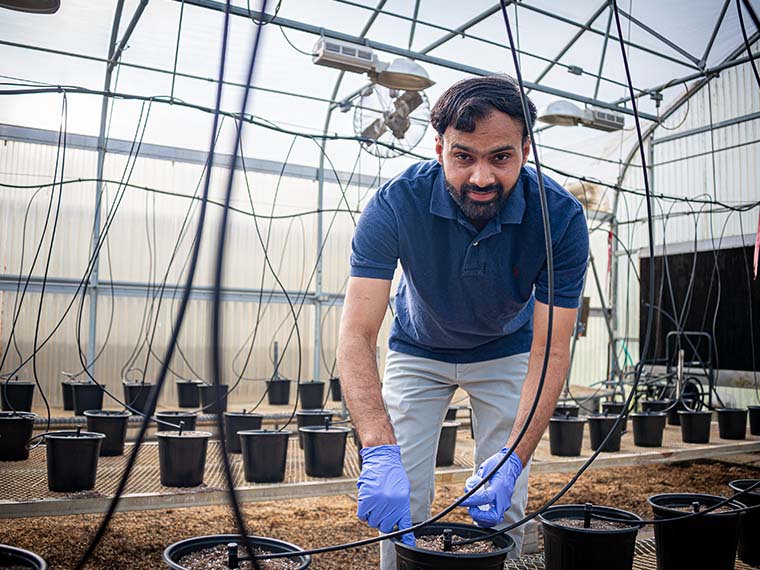
For students in Mississippi State's College of Agriculture and Life Sciences or CALS, there is a common thread: a connection to agriculture and an understanding of its impact on the world around them. That is certainly true for Ehtasham Ali, a doctoral student studying plant pathology in the Department of Agricultural Science and Plant Protection. Even though he grew up nearly 8,000 miles from Mississippi, his story resonates with many of his peers.
"I was raised in a small village in Pakistan where everyone, including my family, was engaged in agriculture," he said. "I remember visiting the fields and noticing how plants growing side by side could look very different, some healthy, while others showed signs of disease."
That early curiosity inspired Ali to pursue a career in agricultural sciences, with a particular focus on plant diseases. His journey began in his home country, at the University of Lahore, where he earned an undergraduate degree in biotechnology while studying the effects of fungal diseases on expression of specific genes in maize hybrids. He later attended the University of Agriculture in Peshawar, earning a master's degree in plant biotechnology and gaining exposure to the intersection of crop science, plant pathology, and molecular biology. When it came time to choose a doctoral program, Ali credits his research advisor with helping him find a home at MSU.
"Before we ever spoke, I was able to learn about the lab and the real-world impact Dr. Lu was having not only on plant sciences, but on human health as well," he said. "I wanted to learn from someone who was passionate about their work, but also a strong teacher and mentor. Dr. Lu is exactly that."
Dr. Shien Lu, a professor in the department and MAFES scientist, is the principal investigator in the plant bacteriology laboratory, where researchers approach plant health by combining molecular analysis with practical applications, using beneficial bacteria to combat and control plant diseases. Ali's research focuses on Macrophomina phaseolina, the pathogen responsible for charcoal rot in soybeans.
Funded by the Mississippi Soybean Promotion Board, Ali aims to identify beneficial bacteria that could help combat one of the most damaging fungal diseases affecting one of the state's most important commodities.
"Our main goal is to develop biopesticides that can reduce the impact of charcoal rot in soybeans," Ali said. "The research is still ongoing, but the preliminary data from a greenhouse experiment showed that some bacterial isolates positively affect the soybean growth and yield under fungal stress as compared to controls. The experiment will be repeated in subsequent years to draw a definitive conclusion."
The study begins by collecting samples of healthy plants with their root systems and soil from diseased patches of charcoal rot within soybean fields. Serially diluted suspensions of the roots and soil are then spread on agar plates and incubated at a suitable temperature to promote bacterial growth. Isolates with antimicrobial activities are identified by spraying them with indicator fungal and bacterial pathogens. These isolates are further identified at the taxonomic, molecular, and phenotypic levels under laboratory conditions before being used on plants. The promising strains are then tested in controlled greenhouse studies, with the goal of producing consistent results that can be shared with policymakers, pesticide developers, and farmers to better inform management strategies.
Ali said that beyond his academic training, Mississippi State University has equipped him with the skills and confidence to succeed after graduation.
"Through events like the International Fiesta, departmental seminars, research presentations, workshops, research symposiums, and networking opportunities, I have become more confident," he said. "English isn't my first language, which I worried would create communication barriers, but I have found a welcoming community that takes the time to learn from one another and grow together."
After graduation, Ali hopes to pursue postdoctoral opportunities and eventually a career in academia, where he can continue developing sustainable solutions for crop disease management. Whether in the U.S. or abroad, he aims to make meaningful contributions while staying connected to his roots in Pakistan and mentoring future scientists. As his research progresses, Ali hopes his work will benefit farmers in Mississippi and beyond by improving disease management, protecting crop yields, and strengthening food systems. His journey from a small village to a leading research institution reflects both personal determination and the broader commitment among Mississippi State students to address global challenges through science and innovation.
This research is funded by the Mississippi Soybean Promotion Board.