
Mapping the Path for Park Access
By: Kaitlyn Church
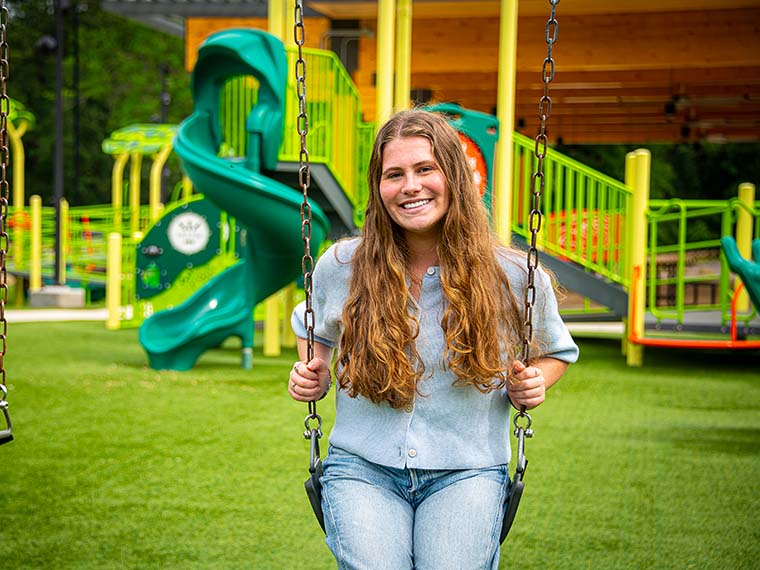
Rachel Bowers at the newly renovated McKee Park in Starkville. (Photo by David Ammon)
For Mississippi State University senior Rachel Bowers, parks have always been more than just green spaces. They are places of connection, movement, and community. Now, she is turning that lifelong appreciation into research that examines who has access to those spaces.
A landscape architecture major in the Department of Landscape Architecture and Environmental Design with a minor in environment and sustainability, Bowers is leading a project titled "Mapping Access: A GIS-Based Analysis of Park Accessibility in Starkville, Mississippi." Her work uses geospatial technology to better understand how accessible parks are across the city and where gaps in access remain.
"I've always loved parks," Bowers said.
"Even in Starkville, I go to local parks to play pickleball, walk with friends, or just relax. But I realized I still have to drive to most places I want to go. That realization sparked a deeper question for me: in a city I care about, how accessible are parks?"
Working with Jason Walker, associate professor in the Department of Landscape Architecture and Environmental Design, Bowers used geographic information systems, or GIS, to analyze park accessibility across Starkville. The project was inspired in part by recent planning efforts, including updates to local parks and a 2021 master plan that raised questions about who these improvements are serving. Using GIS, Bowers mapped 10-minute walking zones around Starkville's parks based on existing sidewalk networks. The benchmark comes from a national initiative by the National Recreation and Park Association, which aims for everyone to live within a 10-minute walk of a park by 2050. She also included informal green spaces, such as school playgrounds, to better capture all potential recreational areas. By layering this information with the locations of affordable housing, Bowers evaluated which communities currently have access to parks and where accessibility gaps exist. Her findings show that while Starkville is making progress, there are still areas for improvement.
"Starkville is doing a good job investing in parks and sidewalks," Bowers said. "But it still has a long way to go before it can meet that 10-minute walk goal."
Bowers found that central Starkville benefits from a higher concentration of parks and pedestrian infrastructure, while southern areas of the city remain largely underserved. Some affordable housing developments fall just outside walkable park zones, limiting residents' ability to easily access these spaces.
"Just because you have a good park doesn't mean it can be used to its full capacity if there's no good way to get there," Bowers said. "Connectivity is just as important as the parks themselves. While informal green spaces help fill some gaps, they are not a complete solution, which reinforces the need for continued investment in park development and pedestrian infrastructure."
Access to parks plays a significant role in community well-being, Bowers explained, offering benefits that range from increased physical activity to improved mental health.
"People are more likely to be active when they have safe, accessible places to walk, play, and spend time outdoors," she said. "Parks also create opportunities for social interaction, strengthening community identity, and supporting environmental health. Ensuring that access is equitable, especially for underserved communities, is a key point of my research."
Originally from Cary, North Carolina, Bowers said her decision to attend Mississippi State was influenced by family ties and the university's welcoming environment.
"As the daughter of an alum, I always heard about how supportive and wonderful the MSU community is," Bowers said. "But experiencing it has been completely a one-of-a-kind experience. Mississippi State wanted me for who I was, and I'm so glad that I made the choice to come to MSU."
Through this project, Bowers said she has developed a deeper interest in using data-driven design to address real-world challenges.
"This research showed me how GIS can be a powerful tool not just for analysis, but for informing planning and design decisions that directly impact people's daily lives."
After graduation, Bowers will continue her academic journey at the University of Michigan, where she plans to pursue a master's degree in urban design. Bowers hopes to build on her work by continuing to explore the relationship between the built and natural environments and the people they serve.
This research was funded by the Mississippi Agricultural and Forestry Experiment Station and the College of Agriculture and Life Sciences Undergraduate Research Scholars Program.