
It's In Our Jeans
MAFES researchers are designing the future of adaptive clothing
By: Carson McFatridge
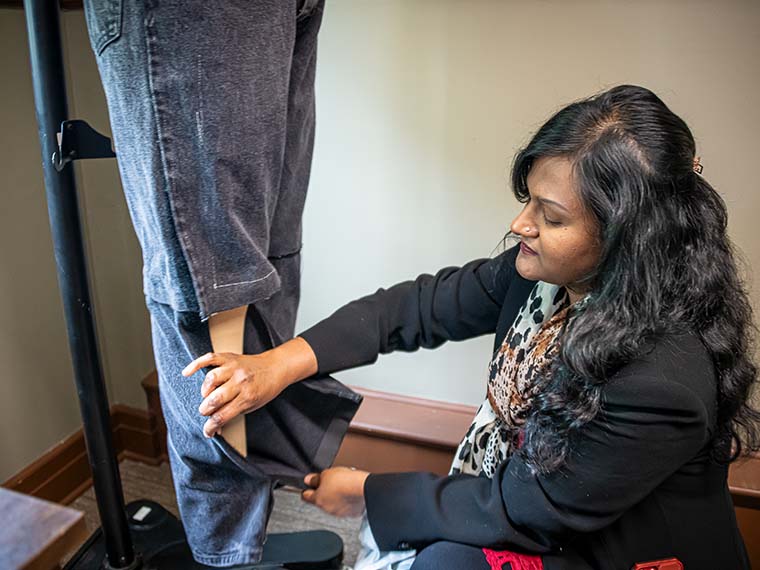
Dr. Farhana Momotaz demonstrates the functionality of jeans that convert into shorts. (Photo by David Ammon)
For many people living with diabetes, daily health challenges extend far beyond blood sugar management. About one in three adults with diabetes may also develop chronic kidney disease, according to the U.S. Centers for Disease Control and Prevention. High blood sugar and high blood pressure, common complications of Type 1 and Type 2 diabetes, can damage blood vessels and nephrons, increasing the risk of kidney dysfunction. Diabetes-related complications such as neuropathy can also reduce mobility and range of motion, making everyday tasks like fastening buttons, zippers, and snaps more difficult.
Recognizing the need for more accessible and functional clothing options, Dr. JuYoung Lee, associate professor, and Dr. Farhana Momotaz, assistant professor, both in Mississippi State University's School of Human Sciences and scientists with the Mississippi Agricultural and Forestry Experiment Station, or MAFES, developed a graduate-level course focused on adaptive and functional apparel innovation. The course encourages students to create research-driven designs that address barriers to accessibility, autonomy, and long-term health monitoring.
"We decided to provide students with the opportunity to engage in design that integrates consumer insights, medical textiles, sportswear, PPE (Personal Protective Equipment), and sustainability," Lee said.
"Our master's student, Rakifull Alam, developed a prototype using the resources from our newly established Wearable and Comfort lab, which I founded with the support from MAFES. This prototype is capable of supporting health monitoring while still maintaining the look and feel of everyday clothing, rather than that of a medical device," Momotaz said.
Alam, a master's student in fashion design and merchandising with a design and product development concentration under Momotaz's supervision, is currently leading the continued development of the prototype in the Wearable and Comfort lab with ongoing support from Lee and Momotaz.
His design, constructed from upcycled cotton denim, combines three key components: modular functionality, sustainable materials, and integrated health-monitoring technology. The adaptive garment features Velcro seams along the sides and knees, allowing the denim to convert easily from full-length pants into shorts. This modular design can simplify dressing and provide easier access for both wearers and caregivers.
The jeans also include a water-resistant cotton fabric pouch coated with thermoplastic polyurethane to improve comfort, durability, and prevent leaks or spills. The discreet pouch inside the clothing provides a lightweight alternative for a urine drainage bag for those individuals who use a catheter. The design prioritizes both comfort, wearability, and practicality while supporting medical functionality.
At the center of the innovation of this project is an integrated urinalysis system connected to a concealed urine collection bag. A newly developed turbidity sensor-based system monitors urine clarity by measuring cloudiness through a light detection mechanism, potentially identifying early signs of kidney dysfunction or infection. The sensor system is paired with a microcontroller capable of converting analog data into digital information that can be displayed on a screen or smartphone, allowing for continuous health monitoring without disrupting daily life.
While the prototype offers promising possibilities for future healthcare applications, several practical challenges remain before it can be widely implemented.
"There are several considerations we must navigate, like the cost of large-scale production or ensuring that the sensors are washable, durable, and comfortable for long-term wear," Lee said. "The most critical factor is user acceptance, so future tests must prove that the device and design are user-friendly and unobtrusive."
The research team is now focused on refining the design to begin real-life trials.
"We are currently working on refining the prototype and obtaining a patent for the technology, and we hope to start human trials soon," Momotaz said. "We have the proof of concept for everything from data collection, product design, performance testing, physiological data tracking, and even mobile app development, but we would need additional funding to expand these efforts and make them feasible for general public use."
As development continues, future versions of technology could incorporate additional sensors capable of monitoring factors such as pH balance or glucose levels, creating a more comprehensive wearable health platform. Researchers are also considering data privacy protection and regulatory requirements to ensure future models meet both medical standards and consumer expectations.
For both Lee and Momotaz, the project highlights the growing potential of interdisciplinary collaboration to address complex, real-world health challenges.
"This project shows how we can integrate fashion, technology, and healthcare," Lee said.
It also demonstrates how research leads to innovation.
"Our students can take research ideas and turn them into tangible, innovative products that have the potential to make a real impact," Momotaz said.
Current funding for the project is provided primarily by the Mississippi Agricultural and Forestry Experiment Station, with additional support from the Cotton Incorporated sponsored Cotton in the Curriculum grant, which emphasizes cotton-based medical textiles, sustainability, and high-performance smart apparel innovation.