
Mapping Hunger Risk
A new model offers flexibility in measuring food security
By: Vanessa Beeson
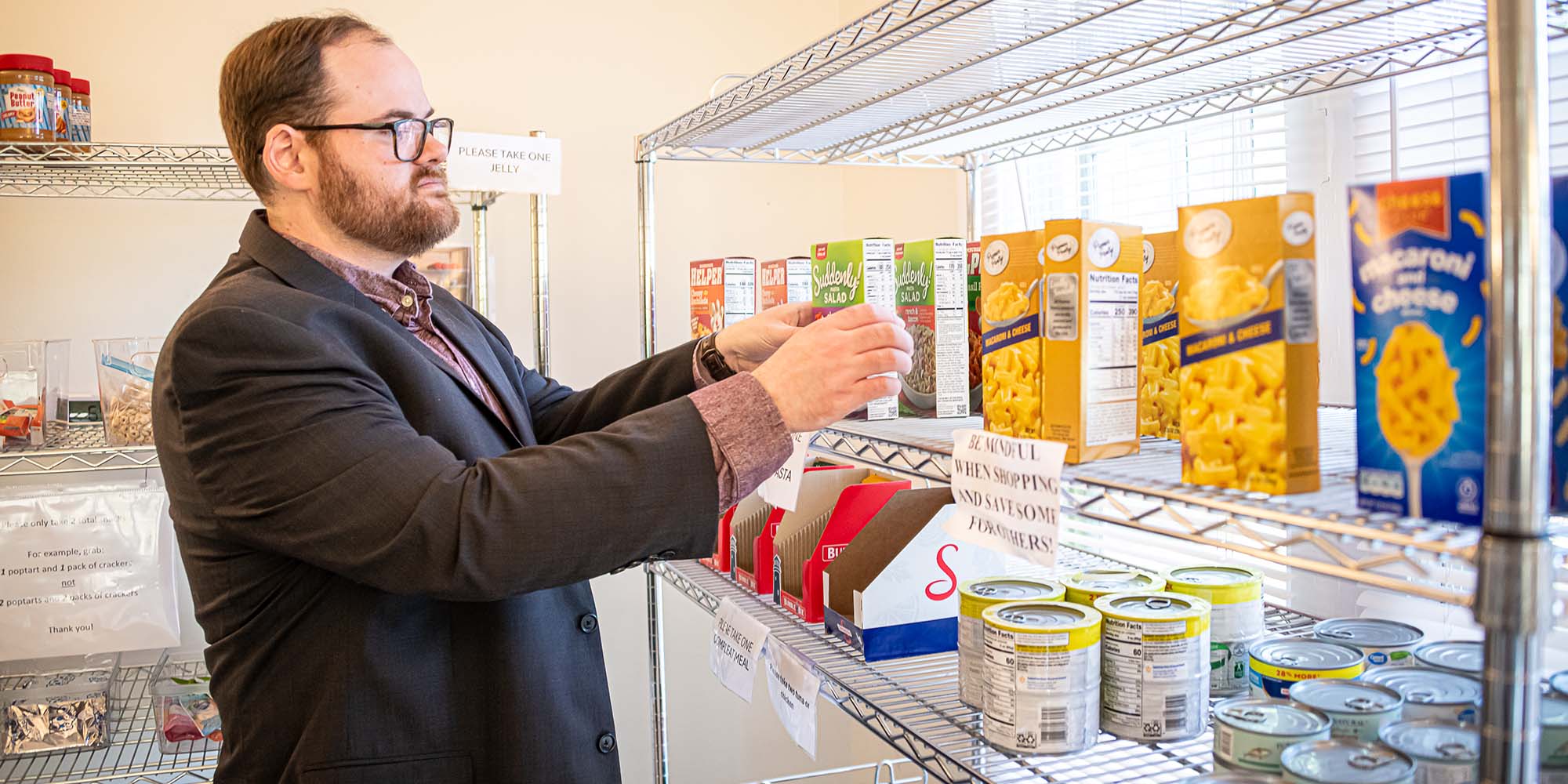
Dr. Will Davis stocks shelves at MSU's Bully Pantry. (Photo by David Ammon)
There is a good chance some of our neighbors, friends, and even family members have experienced food insecurity at some point in their lives. In fact, nearly 48 million people in the U.S., including 14 million children, are food insecure according to the U.S. Department of Agriculture. Food availability, utilization, access, and stability are the four pillars that determine whether a household has enough food. Because of its complexity and the fact that it cannot be directly observed, food security is difficult to measure accurately. Scientists in the Mississippi Agricultural and Forestry Experiment Station, or MAFES, have developed a model to better measure food security, offering a clearer understanding of how many households experience food insecurity and to what level of severity.
Dr. Will Davis, an assistant professor of agricultural economics at Mississippi State and a MAFES scientist, is passionate about the topic.
"I'd like to emphasize just how common food insecurity is with one in seven U.S. households experiencing it at some point during the year. A wide range of reasons from economic constraints to lack of physical access to other structural factors can cause it," he said.
Davis also cares deeply about metrics.
"I never thought I would become an evangelist for measurement, but I'm passionate about it because it's the foundation of all science. If you can't measure something well, you can't understand or improve it," Davis said.
He said identification and monitoring are central to addressing food insecurity.
"First, you need to be able to measure food insecurity accurately. If you can't measure it well, it's very difficult to design effective policies," he said. "Second, you need to monitor it over time. The USDA has been doing this for decades, and our model can fit into that same framework, but with more detailed information," he said.
Davis and his team developed a novel Bayesian Graded Response Model, or BGRM, for food security measurement, which seeks to improve how food security is measured and monitored over time. While the USDA has a strong model that is widely used, Davis and his team found an opportunity to extract more information from the same underlying data.
"Our goal was to develop a data-driven measure of food security, one that uses all available information, and importantly, one that also provides a measure of uncertainty. In doing that, we're addressing several longstanding limitations of the current approach," he said.
The model the USDA currently uses relies on data from the Household Food Security Survey Module, known as the HFSSM, which is a set of 18 questions about a household's food situation. The HFSSM includes binary and categorical data comprised of either 'yes' and 'no' responses or more nuanced answers such as 'often', 'sometimes', and 'never'.
"The challenge is that the USDA's current model can only work with binary responses. So, they must convert those more detailed responses into binary variables. For example, they group 'often' and 'sometimes' together. That means we lose information about severity," Davis said.
The BGRM allows researchers to use both binary and multi-category responses without collapsing them.
"We preserve important details that are missed by the USDA's model. On top of that, we estimate a full distribution of food security for each household. So instead of just assigning a category, we get both a point estimate and a measure of uncertainty," Davis said. "Every statistical estimate has uncertainty, and that matters. Two households might have the same estimated level of food security, but if one estimate is much more uncertain, that has implications for how we interpret it and how policymakers might respond."
Davis and his team drew data from two federal surveys that both contain the HFSSM: the National Health and Nutrition Examination Survey, or NHANES, which is produced by the Centers for Disease Control and Prevention, and the Current Population Survey, or CPS, administered by the U.S. Census.
"NHANES gives us detailed health outcomes, which allows us to validate how our measure relates to things like diet and health while the CPS is nationally representative and what the USDA uses for its official estimates," he said.
Davis said the new model incorporates binary, ordered polytomous, and continuous variables all in one framework.
"That opens the door not just for better food security measurement, but for measuring other complex concepts like nutrition security as well. This is a contribution we are especially proud of," he said.
The team found that USDA food security categories can mask meaningful differences, with households varying widely within the same group and even overlapping across categories, and he said the biggest improvement with the new model was a chance to move beyond broad categories.
"With continuous measurement, we can more precisely identify where households fall in the food security distribution. That helps us better target those who are most at risk," Davis said. "And when you combine that with measures of uncertainty, you get an even clearer picture. If a household has very low food security and low uncertainty, we can be highly confident that they need support. That kind of information is incredibly valuable for targeting interventions effectively."
Davis said the model should help policymakers because it better identifies food insecure households more precisely with a greater measure of confidence.
"This work will help policymakers better allocate resources, whether it's SNAP benefits, other government nutrition assistance programs, or local interventions, and target them more effectively to the people who need them most."
Davis hopes to aggregate the model to a community level and expand the work to related areas.
"From a research perspective, this model provides a much more flexible framework for measuring complex concepts. That opens the door to expanding beyond food security into things like nutrition security, diet quality, and other related outcomes that require a mix of different variable types," said Davis, who noted the framework will allow them to integrate new types of data. "As more data become available, whether that's administrative data, geographic information, or even real-time indicators, we can incorporate those into the model to get an even more complete picture."
Craig Gundersen, Snee Family Endowed Chair and professor in the Department of Economics at Baylor University and creator of Feeding America's Map the Meal Gap project, said the research will help scientists better understand food insecurity.
"The most important thing is that oftentimes, we treat food insecurity as either you are food insecure or you're not food insecure. But there's a lot of ambiguity as to whether somebody crosses the threshold of food insecurity," he said. "This work gives us more nuance to understand whether somebody is food insecure."
Ultimately, Davis hopes the work will help inform policy.
"I see this as a step toward more precise, data-driven policymaking, where we're not just identifying problems, but understanding them in a way that leads to more effective solutions," he said.
Collaborators include Drs. Jose Xilau and Rusty Tchernis from Georgia State University and Dr. Christian Gregory from the Economic Research Service of the U.S. Department of Agriculture. The findings were presented in the NBER Working Papers of the National Bureau of Economic Research, Inc. and published in the American Journal of Agricultural Economics.
This research was supported in part by the US Department of Agriculture, Economic Research Service, cooperative agreement number 58-4000-8-0027 and the Mississippi Agricultural and Forestry Experiment Station.
Our goal was to develop a data-driven measure of food security, one that uses all available information, and importantly, one that also provides a measure of uncertainty. In doing that, we're addressing several longstanding limitations of the current approach.
Dr. Will Davis
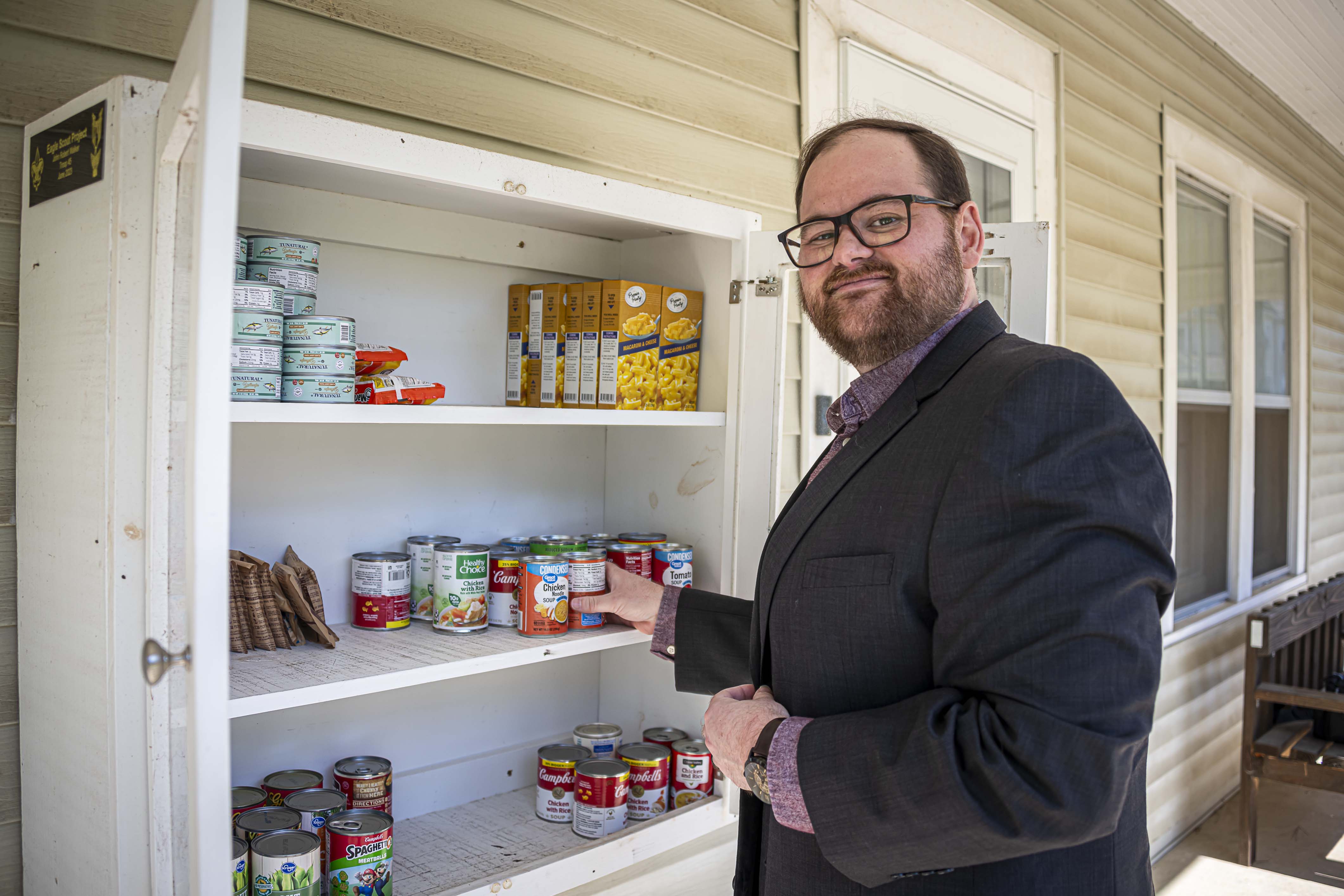
Dr. Will Davis adds food to the outdoor food pantry box at MSU's Bully Pantry. (Photo by David Ammon)
Behind the Science
Will Davis
Assistant Professor
Education: B.S., Economics, The University of Alabama at Birmingham; M.A., Ph.D., Economics, Georgia State University
Years At MSU: 3
Focus: Health economics, food policy, and econometrics
Passion At Work: I am passionate about working toward a world where every person in every place has what they need to live their best life. Specifically, how can we use science, policy, and healthcare to make improvements in the lives of those that need it most?