
The Cost of Distance
Rural families and the road to healthcare
By: Vanessa Beeson
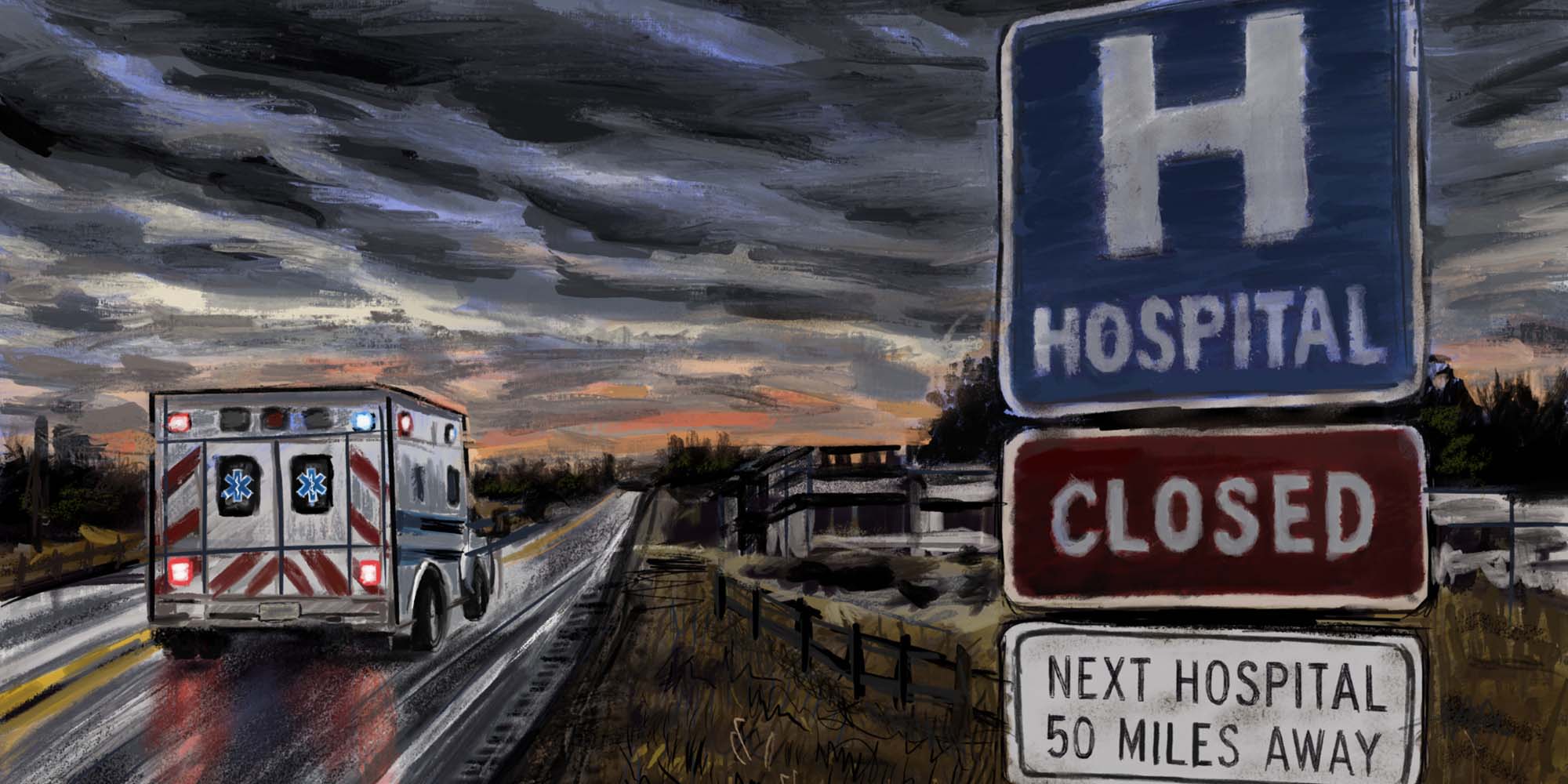
According to the USDA, 146 rural hospitals closed or stopped providing inpatient services from 2005 to 2023 in the U.S. (Illustration by Dominique Belcher)
Dr. Leah Pylate grew up in Marble Hill, Missouri, on the outskirts of Cape Girardeau. In the sparsely populated Delta landscape, she saw firsthand the challenges her grandparents faced because of limited healthcare access in the Missouri Bootheel. That understanding of rural healthcare needs has shaped her career.
Now an assistant professor in Mississippi State University's Department of Biochemistry, Nutrition and Health Promotion and a scientist with the Mississippi Agricultural and Forestry Experiment Station, or MAFES, Pylate is part of a 30-year, 27-state, research effort examining the well-being of rural families.
The project, titled Rural Families Speak, began in 1996 to examine how welfare reform affected rural communities. In the 2010s, the focus shifted toward health and resilience among rural residents. Pylate joined the project in 2021 as researchers expanded their work to examine the sustainability of rural families, communities, and systems.
"What's unique is the systems approach. We are studying how individuals and families function within broader systems, with a focus on improving overall functioning, both at the family level and individually, particularly for mothers," Pylate said. "Our more recent effort is the culmination of years of work, both qualitative and quantitative, capturing how rural families experience health and well-being across time."
Pylate's work contributes to a broader effort examining how environmental, economic, and social systems interact with family systems to influence resilience and well-being among diverse, low-income rural families. Using data analysis, stakeholder collaboration, and outreach efforts, the team works to identify locally relevant strategies that support long-term health and sustainability.
"It's been an interesting and great opportunity to work alongside other researchers who have spent years evaluating how rural families navigate the healthcare landscape," she said.
Pylate contributes to both qualitative and quantitative studies tied to sustainability and health outcomes.
"Our recent quantitative work includes more than 1,000 participants and focuses on mothers supporting their families," she said. "In our qualitative work, we interviewed healthcare providers and community members to understand resilience, in particular, how food systems adapted during COVID-19 and how that affected families."
Researchers combined survey and interview data from rural, low-income families to examine physical and mental health, healthcare access, economic stability, and family connections. By analyzing data over time, the team identified patterns and factors that either increased or reduced risk for families.
The researchers found that rural, low-income families face elevated risks tied to limited healthcare access, economic instability, and geographic isolation. Long travel distances, provider shortages, transportation barriers, and gaps in insurance coverage often make preventive and ongoing care difficult to obtain. Various studies have been conducted in the project, and some of the findings note many participants reporting risk factors such as poor diet, low physical activity, and tobacco use, while access to healthy food and routine medical care remained inconsistent.
"We sought to better understand how individuals, specifically mothers, and families function in the context of the larger system," she said. "When we think about health, we often focus on the physical, but it's much broader. Mental, social, and systemic factors all play a role."
Pylate said the research highlighted both the challenges and strengths found within rural communities.
"We need more rural healthcare providers and solutions for things like transportation. We need to consider the length of time it takes to travel to a doctor's office and think of what goes into that long-distance drive, from money spent on gas to time taken off work. These items require action as families are having to choose between needs," Pylate said.
At the same time, researchers observed strong community resilience.
"One of the biggest takeaways is how resilient rural families and communities are. During COVID-19, we saw the strength of social networks including neighbors, churches, and communities stepping in to support one another," said Pylate, who noted other benefits of rural communities. "We often focus on challenges like distance or provider shortages, but rural areas also offer advantages like access to nature, which can positively impact health."
Rural Families Speak created one of the most comprehensive datasets in the U.S. focused on low-income rural family well-being. The research has informed Extension educators, health professionals, family-serving organizations, and policymakers by documenting real barriers rural low-income families face, including child care, transportation, employment, food security, healthcare access, health literacy, depression, family support, and public assistance. The team has translated those findings into publications, briefs, outreach tools, and the "Relying on Rural Resilience" webinar series.
The "Relying on Rural Resilience" webinar series brings together researchers, Extension professionals and rural service providers to address issues affecting low-income rural families, including food insecurity, recovery programs, mental health, healthcare access, economic stress, parenting and family resilience. The series highlights both the challenges and strengths of rural families and communities while helping participants develop practical, research-based strategies to better support rural households.
The project is funded through the Hatch Act of 1887, a program administered by the USDA National Institute of Food and Agriculture and designed to fund research at agricultural experiment stations to solve complex issues that concern more than one state.
Dr. Brianna Routh, associate professor at Montana State University and chair of the project, said the project's mission has remained consistent, even as the work has evolved through multiple five-year Hatch project renewals.
"The project has gone through multiple iterations, as Hatch projects typically renew every five years. While the research has evolved, we've maintained a consistent focus on giving a voice to rural families and their experiences," she said.
The project also includes an educational component through student mentorship and outreach.
"As a Hatch project, we measure success not only through scholarship but also through student involvement, mentorship, and the development of outreach tools that support rural communities," Routh said.
Routh said one of the most meaningful aspects of the project is ensuring rural residents feel represented and heard.
"The most rewarding part of this work is giving voice to populations that don't always feel heard and sharing their experiences in ways that improve how we serve rural communities."
Pylate echoed that sentiment.
"Solutions need to be informed by people in rural areas and should include their needs. Their input is valuable to sustainable progress," she said.
She said the work also provides an opportunity to give back to communities similar to the one where she was raised.
"This work helps highlight inequalities in resources, infrastructure, and opportunity found in rural communities, especially for low-income families, and shows how those differences affect access to care," Pylate said.
"I think the work we do, especially regarding low-income families, highlights different needs that must be met in terms of access and sheds more light from a systematic perspective. I hope I do this work justice to make a small impact on such a huge project."
For more information on the project, visit Rural Families Speak | HATCH Research Project online.
This research was supported in part by USDA/CSREES/NRICGP Grant Number 2001-35401-10215 and 2002-35401-11591, 2004-35401-14938. Data were collected in conjunction with the cooperative multistate research projects: (1) NC223/1011, Rural Low-Income Families: Monitoring Their Well-Being and Functioning in the Context of Welfare Reform (commonly known as "Rural Families Speak") and (2) NC1171, Interactions of Individual, Family, Community, and Policy Contexts on the Mental and Physical Health of Diverse Rural Low Income Families (commonly known as "Rural Families Speak About Health").
When we think about health, we often focus on the physical, but it's much broader. Mental, social, and systemic factors all play a role.
Dr. Leah Pylate
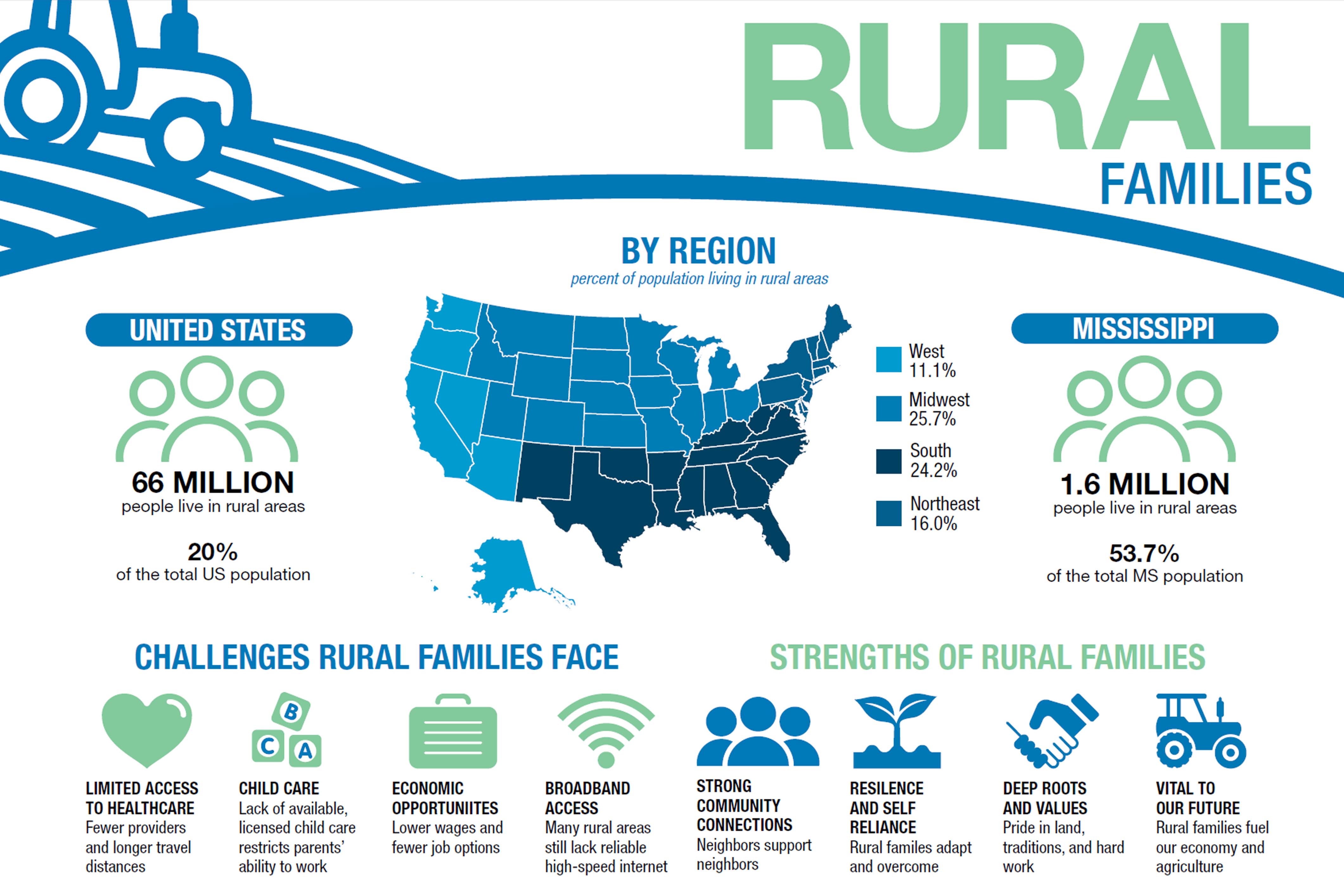
Sources: U.S. Census Bureau, USDA Economic Research Service, National Conference of State Legislators, Rural Families Speak
Behind the Science

Leah Pylate
Associate Professor
Education: B.S., Health Management, Southeast Missouri State University; MBA and M.S., Food Science, Nutrition, and Health Promotion; Ph.D., Human Development and Family Science, Mississippi State University
Years At MSU: 15
Focus: Family recovery and college student health
Passion At Work: Educating and supporting families who are working through a recovery process from alcohol, drugs, or an addictive behavior with their loved ones.