
Adapting to Change
MAFES Coastal Plain Branch Evolves to Meet Mississippi's Agricultural Needs
By: Karen Brasher
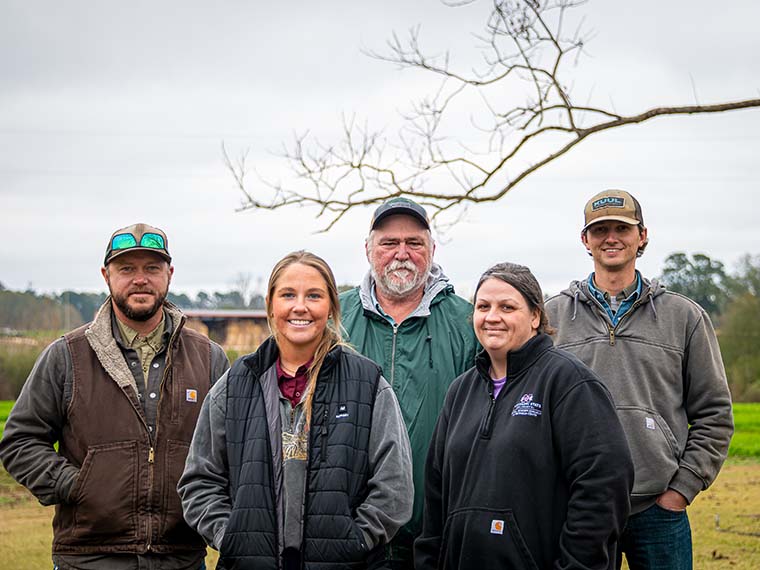
Left to Right: Dr. Brett Rushing, Adaline Rouse, Danny Todd, Jenna Mosley, and John Clay Lyles. (Photo by Karen Brasher)
In Mississippi's agricultural research landscape, adaptability is essential—and the Mississippi Agricultural and Forestry Experiment Station's Coastal Plain Branch in Newton demonstrates it well. Once home to one of the county's larger dairies, the station has evolved alongside the needs of local producers and the region's shifting economy.
For decades, Newton's dairy industry thrived with support from Kraft Foods—later McClendon Cheese Company and McClendon Dairy Products—which processed milk from numerous small farms across the county. When the plants closed, dairy production declined, and pine replaced pastures throughout the area. At the Coastal Plain Branch, the dairy herd was sold in 2005, paving the way for new research opportunities focused on beef cattle and forages. Its roughly 1,000 acres provide an ideal landscape to study grazing systems.
Jenna Mosley, a Newton native, has witnessed this transition firsthand. She began working at the station as a student and has now spent 23 years contributing to its mission. As office associate, she is a vital part of daily operations and has remained a steady presence throughout the station's evolution.
Brett Rushing, Extension and MAFES research professor, has spent the past 11 years shaping the station's forage and cover crop research. Though trained as an agronomist, his work has spanned native plants for roadways and wildlife habitats, as well as bioenergy and conservation grasses—earning him several patents. As producers' needs have changed, Rushing has shifted focus to cover crops for grazing.
"Farmers are looking for ways to diversify," Rushing said. "Profits from commodities are going down while beef cattle prices are rising. Using cover crops for cattle grazing followed by a commodity doubles revenue on a per-acre basis."
To support this work, the station includes 18 two-acre paddocks dedicated to evaluating grazing systems and subsequent crop performance. Graduate assistant Adaline Rouse, a Mississippi State University master's student in agronomy and Vancleave native, is studying how crop rotation and tillage practices influence soybean yields following grazed cover crops. Her Mississippi Soybean Promotion Board-funded project will also explore soil health changes after 5,000 pounds of cattle graze the cool-season forages.
Rouse grew up on a cow-calf operation, as did research associate John Clay Lyles. A Lawrence native, Lyles started at the station as a student intern 11 years ago and later joined full-time. He now plants and maintains row crops in spring and summer, manages cover crops in fall and winter, and assists with livestock care—all central to the research program.
The team also includes assistant farm supervisor Danny Todd of Hickory, who joined the station 20 years ago after a 25-year career with Peavey Electronics. Together, the staff manage roughly 90 head of cattle and maintain a diverse research landscape of perennial pastures surrounded by pine and hardwood forests. In addition to cover-crop grazing studies and row-crop rotations, the station hosts the MAFES Official Forage Variety Trials.
Conveniently located between I-20 and Highway 80, the MAFES Coastal Plain Branch welcomes a variety of groups throughout the year, including Extension 4-H programs, professional organizations, and field day participants from across central Mississippi.
"We are fortunate to be able to work this land for the benefit of Mississippians," Rushing said. "Our research is making an impact for producers."