
Winter Cover Crops Target Herbicide-Resistant Weeds
By: Kaitlyn Church
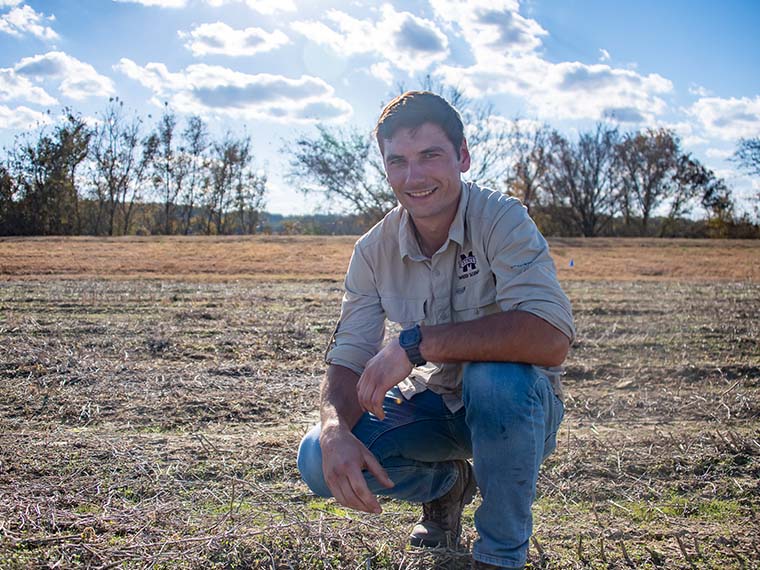
Junior Borkowski examines a field at the MAFES R.R. Foil Plant Science Research Center. (Photo by Dominique Belcher)
As the push for sustainable farming practices grows, one Mississippi State University researcher is looking to help local farmers tackle one of agriculture's toughest problems: herbicide-resistant weeds.
Junior Borkowski, a master's student in the Department of Plant and Soil Sciences, is examining the potential of winter cover crops as an alternative strategy to help farmers manage Italian ryegrass, one of the most troublesome weeds facing corn growers in the state.
Borkowski, originally from Guarani das Missões, Brazil, has deep roots in agriculture. Growing up on a family farm that produced soybeans, wheat, corn, and dairy, he learned firsthand the complexity of farming and the importance of developing solutions to real-world problems. His research interest was sparked by his undergraduate research experience at the Universidade Federal da Fronteira Sul in Brazil. That research experience led Borkowski to pursue a master's degree in plant and soil sciences at Mississippi State University under the mentorship of Dr. Luis Avila, associate professor, Mississippi Agricultural and Forestry Experiment Station scientist, and the Dr. Glover B. Triplett Endowed Chair.
"Growing up on a farm, I saw the challenges farmers face in controlling weeds, and that's something I've always wanted to solve," Borkowski said. "The research we're doing now could directly impact how farmers manage weeds like Italian ryegrass, which is a big problem in corn fields."
Borkowski's research focuses on integrating winter cover crops with residual herbicide applications to suppress Italian ryegrass, a major weed that competes with crops for nutrients and water. He aims to determine whether specific winter cover crops, when combined with herbicide applications, can reduce ryegrass populations and seed banks over multiple growing seasons.
"Ryegrass is a significant problem for corn producers in Mississippi, especially with herbicide-resistant populations becoming more common," Borkowski said. "What we're testing is whether winter cover crops can help manage ryegrass before it becomes a problem in the summer crops."
Borkowski and his team are evaluating a variety of cover crops, including rye, barley, black oat, rapeseed, and winter radish, both in single-species plantings and in mixtures with nitrogen-fixing species. They are also testing several herbicides-S-metolachlor, pyroxasulfone, metribuzin, and fluthiacet-methyl—commonly used to control ryegrass to see how they interact with the cover crops. Some cover crops, like legumes, are especially promising because they can fix nitrogen, benefiting the corn crop that follows.
"The idea is to use the cover crops to suppress the ryegrass during the fall and winter, then reap the benefits when corn is planted in the spring," Borkowski said. "We want to reduce the weeds' resistance to herbicides and improve the overall sustainability of the farming system."
A preliminary greenhouse study indicated certain cover crops, such as cereal rye, black oat, barley and hairy vetch, can tolerate residual herbicides better than others, which is key to their success in the field. Borkowski is now testing in the field, planting cover crops this fall.
"We know that herbicide resistance is a growing issue, and this research could help farmers better manage their weed pressure without relying so heavily on chemicals," Borkowski said. "In the future, cover crops could be a key part of weed management strategies, and I'm excited to see how it unfolds."
As Borkowski continues his research, he hopes his work will encourage farmers to explore the potential benefits of cover crops, even if they have been hesitant due to concerns about added costs or the complexity of implementation.
"I think the key message for farmers is that cover crops are more than just an expense—they're an investment in long-term sustainability," Borkowski said. "We need to look beyond just one season of planting and think about how we can create more resilient systems that will work for us in the years to come."
After completing his master's degree, Borkowski plans to continue his research in weed management, potentially pursuing a doctorate to deepen his expertise in sustainable agriculture.
"This project is just the beginning," Borkowski said. "If we can show that cover crops are effective, I hope farmers will feel more confident using them to improve their weed control systems and overall farm sustainability."
This research is funded by the Mississippi Corn Promotion Board.