
Hatching Solutions for Chick Mortalities
By: Meg Henderson
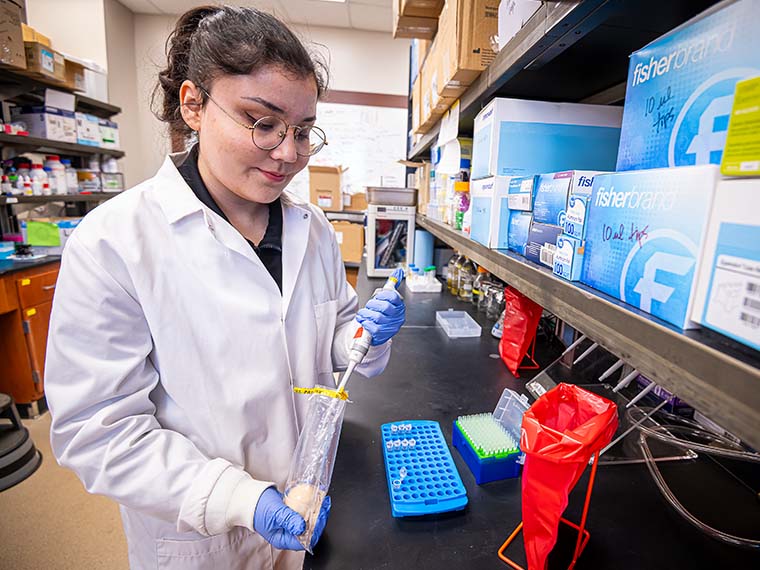
Dilber Annageldiyeva uses a pipette to inoculate an egg. (Photo by David Ammon)
For Dilber Annageldiyeva, conducting rigorous scientific research is like hatching an egg: it requires nurturing an idea until it's fully developed, adding time and patience in the process, and then, an idea may fully evolve into something new.
Three years ago, the junior biochemistry major moved halfway around the world from her home in Turkmenistan to Starkville because Mississippi State provided the best opportunities for research in her area of interest. Although she did not grow up on a farm, Annageldiyeva explained that the agricultural industry is vital in her home country. Knowing people who work in industry also helped steer her academic path toward agriculture.
"I'm very motivated and passionate about research, so I'd like to continue my studies after graduation," she said. "After that, I want to go home and start a career where I can help my community with everything I've learned here."
This semester, Annageldiyeva entered the College of Agriculture and Life Sciences Undergraduate Research Scholars Program. Through the program, she joined a research study under Dr. Maryam Mohammadi-Aragh, an assistant research professor in the Department of Agricultural and Biological Engineering, which focused on exploring the behavior of a pervasive pathogen responsible for premature chick mortalities.
The bacterium E. coli is widely known to cause food-borne illness when outbreaks occur in the food system. A lesser-known type of E. coli, called Avian Pathogenic Escherichia Coli (APEC), is specific to poultry and can cause severe infections in birds. It is also a factor in embryonic and early chick mortalities, as well as poor bird performance. Some eggs arrive at the hatchery already infected, while others become contaminated through exposure to infected eggs or contaminated hatchery surfaces, which can ultimately infect newly hatched chicks. But exactly how they travel throughout the hatchery environment to the egg or chick remains poorly understood. Mohammadi's study builds on incubation trials conducted at the USDA Poultry Research Unit in Starkville under Dr. Jessica Drewry, which yielded data suggesting that various environmental factors within incubators may play a role in reducing the spread of E. coli.
The study's ultimate objective is to develop computer models informed by experimental data, which will help poultry integrators better understand and mitigate the spread of the bacteria to the eggs and newly hatched chicks.
"What we've noticed over the years is a steady decline in egg viability," Mohammadi said. "We're observing fewer chicks hatching, partly due to APEC infections, and aim to develop engineering solutions to mitigate disease and improve overall hatchability. What we're investigating, and what Dilber is helping us with, is understanding how the environment impacts E. coli transmission."
Annageldiyeva's work is performed at the Department of Agricultural and Biological Engineering, where she enumerates native E. coli populations on hatching eggs, and performs E. coli inoculation studies to identify how manipulating environmental factors within the incubator impact E. coli survivability.
"We're changing different conditions in the environment—moisture levels, nutrient levels, and incubation temperature in the incubator," she said. "My work has been focused on culturing E. coli from surfaces where the chicks are hatched and other areas that might be a source of contamination. I'm also collecting data that will ultimately help us draw conclusions about the bacteria."
Although she is relatively new to the study, she brings a wise perspective to the work and to scientific research in general.
"Doing research in a lab is like making Manti, a traditional meat-stuffed dumpling in the Turkmen culture," she said. "Cooking Manti requires a lot of patience, passion, and attention to small details, and you need to bring that same mindset into the lab."
This research was funded by the Mississippi Agricultural and Forestry Experiment Station.