
Greener Pastures
MSU researchers are supporting cattle producers starting in their pastures
By: Carson McFatridge
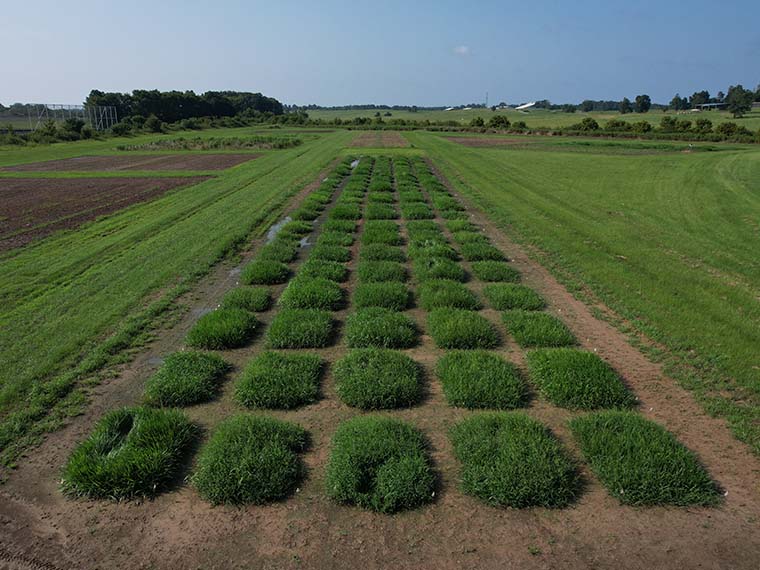
MAFES Official Forage Variety Trials, like these conducted at the MAFES H. H. Leveck Animal Research Center, measure germination and performance of forages. (Photo submitted)
September 2025 marked historic highs in the cost of beef. Ground beef was priced at $8.18 per pound, and steak weighed in at $12.25 per pound, according to the Bureau of Labor Statistics. While many consumers assume that beef producers have it made, these prices merely reflect the rising input costs of raising cattle. Many farmers are struggling to maintain their operations as the cost of fuel, labor, feed, and other inputs increase year after year.
While prices increase, cattle herds are declining—the smallest they have been in 75 years—causing demand to surpass supply.
As input costs rise, Mississippi Agricultural and Forestry Experiment Station, or MAFES, scientists are studying ways to reduce feed costs for cattle producers in Mississippi and beyond. The project, led by MAFES scientists and Mississippi State University Extension specialists in the Department of Plant and Soil Sciences, included Dr. Rocky Lemus, extension and research professor; Dr. Joshua White, assistant professor of practice and manager of MAFES Forage Variety Testing; and Dr. Brett Rushing, extension and research professor stationed at the MAFES Coastal Plain Branch. Lemus shared the tough reality faced by cattle producers in Mississippi.
"In Mississippi we have about six months of summer," he said. "Most of our warm season grasses like Pearl Millet, Sorghum Sudan, and Forage Sorghum have between 70 and 90 days of productivity, leaving us with a three-month gap in forage availability."
There are two ways to close this gap. The first, and most common, is cutting hay. Across the Southeast, landowners cut, rake, and bale their pastures starting in the spring to store forage for later use or to sell to other producers. This practice is financially expensive and time-consuming, whether you do it yourself or hire contract labor, and it always yields a product with a lower forage nutritive value than grazed, live plant material. The alternative to this less-than-ideal solution is to plant or manage for species that would extend the grazing season. For the past three years, MAFES researchers have studied the possibility of introducing Brachiaria to pastures throughout the state.
"Brachiaria is a tropical perennial warm-season grass that could be used as a summer annual forage, but little is known about its production and fertilization requirements in the Southern U.S.," said Lemus, who got the idea from evaluating tropical forages in Costa Rica.
Initially, the researchers identified which varieties of the grass were available for commercial purchase. Through a collaboration with Barenbrug Seed USA, Barenbrug Seed Brazil, and Tropical Seeds, Lemus obtained what was needed to begin testing the germination time of the cultivar. Based on numerous trials, a 30-day spring germination period was determined. This would allow producers to plant Brachiaria as a supplementary pasture forage when typical Bermuda and Bahia fields have lost palatability and nutritive value.
Next, the team sought to determine which variety was best suited for Mississippi and what the fertility management would look like for growers. These tests were conducted both in Starkville and at the MAFES Coastal Plain Branch in Newton, allowing researchers to test success across a variety of soil types. Through this process, it was discovered that the fertility requirements of the species were relatively low, needing only about 50 units of nitrogen to be successful.
Dr. Joshua White added that the plant provided multiple soil health benefits as well.
"Brachiaria has a uniquely elaborate fibrous root system," White said. "It not only scavenges nitrogen well, reducing application rates for landowners, but also prevents soil erosion and promotes the growth of subterranean biological activity."
Looking ahead, the team hopes to establish a breeding program. One issue with the species is its inability to survive the winter. Temperatures in Mississippi's subtropical climate are cooler than the plant is accustomed to. In its native regions, Brachiaria is a perennial plant, so extending that capacity to this region would greatly benefit producers, as they would not need to invest in planting year after year. Once a suitable variety has been established, economic evaluations will ensure landowners are able to make informed decisions for their operations.
The Brachiaria research is paving the way for practical, science-based solutions to address producers' needs. By exploring new forage options that can stretch the grazing season, improve soil health, and lower feed expenses, MAFES researchers and MSU Extension Service specialists are working together with producers to strengthen the cattle industry from the ground up. Though challenges like seed availability and winter survival remain, the collaborative effort is driving real progress. Together, they're creating opportunities that not only support the livelihoods of today's farmers but may also help secure the future of beef production across the Southeast.
This research is funded by the Mississippi Agricultural and Forestry Experiment Station and supported by USDA and NRCS. Barenburg USA and Tropical Seeds has been instrumental in supplying experimental seeds.
Brachiaria is a tropical perennial warm-season grass that could be used as a summer annual forage, but little is known about its production and fertilization requirements in the Southern U.S.
Dr. Rocky Lemus
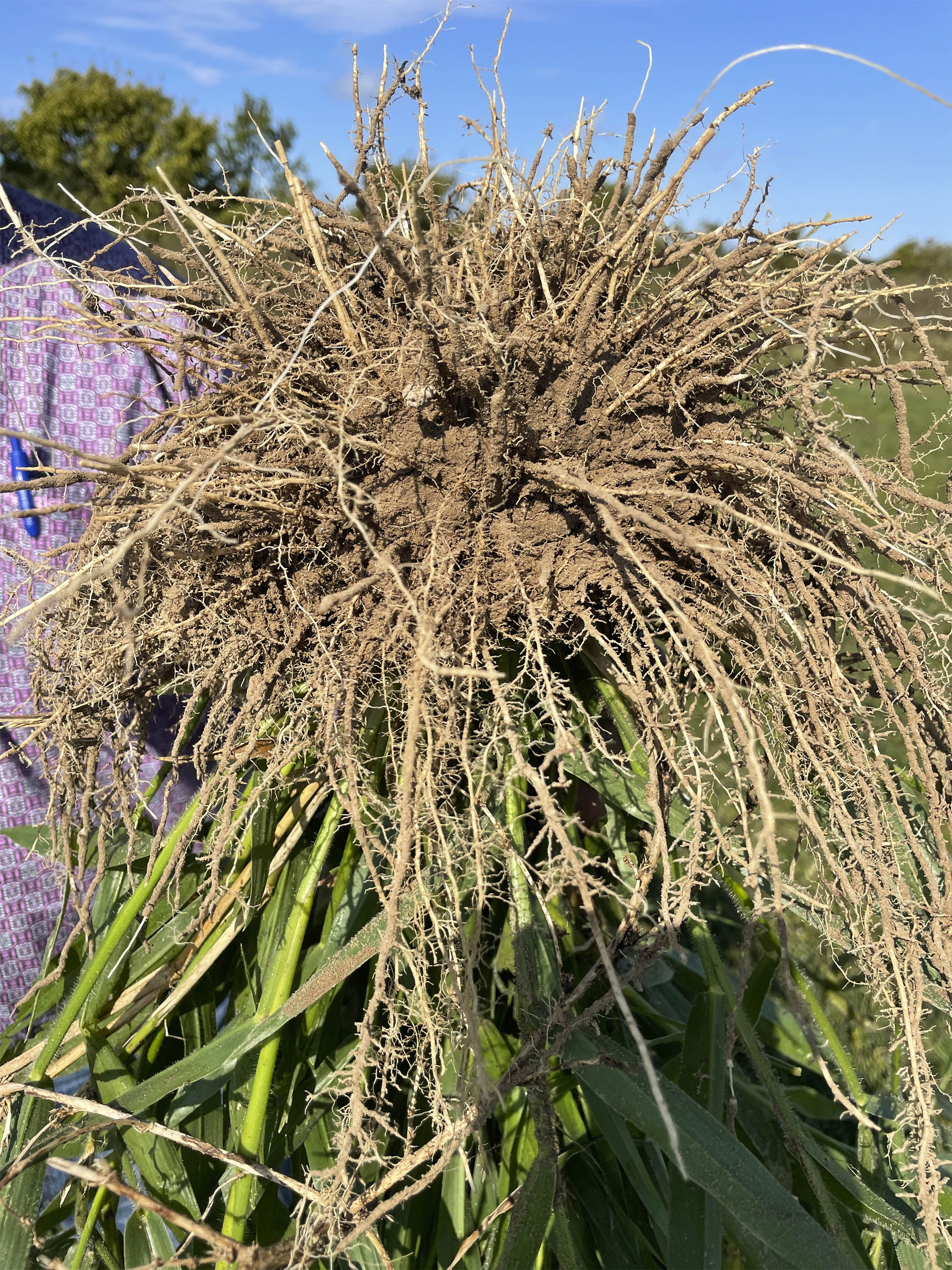
Brachiaria has a fibrous root system, allowing it to scavenge nitrogen, prevent soil erosion, and promote underground biological activity. (Photo submitted)
Behind the Science

Brett Rushing
Extension/Research Professor
Education: B.S., Biology, Jacksonville State University; M.S.; Ph.D., Agronomy, Mississippi State University
Years At MSU: 16
Focus: Forages, biofuel crops, and conservation species
Passion At Work: My split appointment allows me to conduct applied research while simultaneously delivering the results of our work directly to the producers that need it.

Joshua White
Assistant Professor of Practice
Education: B.S. Animal Science; M.S., Agriculture Science, Tarleton State University; Ph.D., Agronomy, Mississippi State University
Years At MSU: 14
Focus: Forage and cover crop variety testing
Passion At Work: Interested in the research of the application and adoption of new varieties and species of forage crops to benefit Mississippi livestock producers.

Rocky Lemus
Extension/Research Professor
Education: B.S., Biology; M.S., Crop Physiology and Production, Iowa State University; Ph.D., Crop and Soil Environmental Sciences, Virginia Polytechnic Institute and State University
Years At MSU: 18
Focus: Explore ways to create sustainable forage production systems persistent in our climatic conditions while providing economic returns. Reduce nutrient losses and integrate legumes that increase nutrition for livestock. Extend the grazing season using high-quality feed sources and apply environmentally sound practices and land stewardship.
Passion At Work: My mission is to increase the overall efficiency, resiliency, and economic value of forage systems to provide a more long-term sustainable approach for the livestock industry in the Southern U.S.