
From Table to Coop
Using post-consumer food scraps in commercial chicken feed
By: Vanessa Beeson
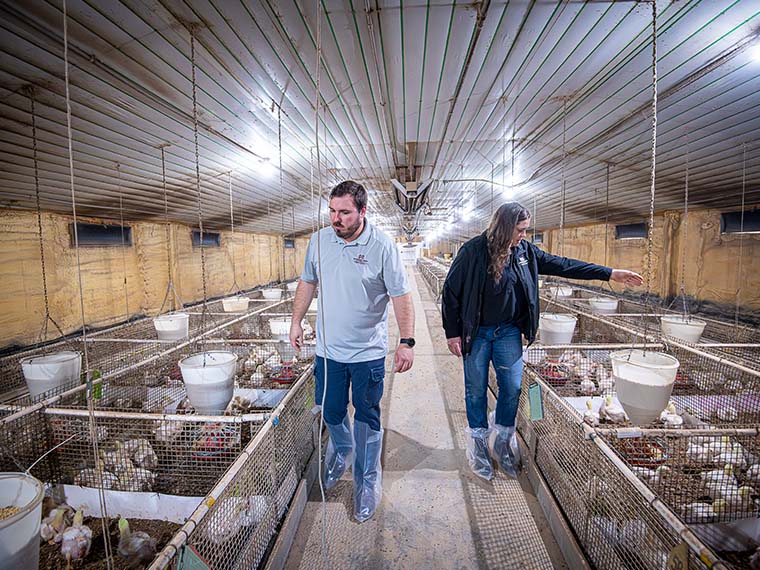
Drs. Tim Boltz and Kelley Wamsley walk through the broiler house to observe birds. The scientists work on nutritious feed formulations that support bird health while reducing producer costs. (Photo by David Ammon)
Anyone with backyard birds will tell you food scraps supplement their flock's diet. In commercial poultry production, however, feed for both egg layers and broilers is precisely formulated to meet the birds' nutritional needs to ensure consistent and efficient growth and production as well as overall health. Researchers from the Mississippi Agricultural and Forestry Experiment Station, or MAFES, helped one company explore how to introduce dried and ground household food scraps into this process in a safe and standardized way
Mill, a waste prevention technology company, partnered with Mississippi State University's MAFES researchers to determine the inclusion levels its processed, dehydrated household food scrap product could be incorporated into commercial poultry diets without negatively affecting performance.
Food waste is a major issue in the U.S. According to the U.S. Environmental Protection Agency, an estimated 66 million pounds of food are discarded each year, nearly half of which originates from households. For many consumers, composting can be difficult due to space, time, climate, or accessibility. Mill is a floor-standing, fully automated, odorless food recycler that dries and grinds food scraps. Customers who have opted into Mill's pickup service empty the dried grounds from the food recycler into a liner and prepaid box that is picked up and delivered to their feed manufacturing facility in Mukilteo, Washington.
The final product tested by the MAFES team of researchers was Mill's commercial feed ingredient made from aggregated grounds from hundreds of households across the U.S. that were inspected, further processed, and evaluated for nutritional composition at their Mukilteo facility. This final product meets the definition for Dried Recovered Household Food (DRHF), an American Association of Feed Control Officials listed ingredient (AAFCO 40.113). Researchers found it contained approximately 16% crude protein, 7% fiber, and 3% calcium.
With these values in mind, MAFES poultry nutritionists incorporated Mill's commercial feed ingredient into balanced mash diets to evaluate how it affected bird performance and digesta viscosity, which influences how nutrients move through the gut and are absorbed.
Dr. Kelley Wamsley, poultry science professor and MAFES scientist, said the work allowed the team to explore a real-world sustainability issue while considering one of the industry's biggest economic factors.
"While feed costs may vary across the industry due to differing markets, consumer demand, and production goals, the big picture is the same across: feed typically represents 60 to 70% of the total cost to raise a bird. Regardless of it being a layer, with the goal of producing an egg—or a broiler, with the goal of producing poultry meat—it's a major investment. Producers use different feeding strategies to meet these goals efficiently and are creative in utilizing a variety of ingredients to raise a healthy bird and make sure it gets the nutrients it needs," she said.
The first study evaluated commercial egg layers over a twelve-week period. A standard layer diet was used to create four dietary treatments: an industry-standard control and diets containing 6, 12, and 18% DRHF, replacing corn and soybean meal. The study involved 256 hens, grouped into 16 replicate pens per dietary treatment. Hens were arranged in conventional A frame type cages with four hens per cage with each cage an experimental unit.
Birds entered the study at 35 weeks of age and remained on treatment diets until 47 weeks. Egg production and egg mass were recorded daily; feed intake and body weight were monitored weekly throughout the trial. Hens receiving 18% inclusion showed lower hen-day egg production and egg mass compared to the 0, 6, and 12% groups, which performed similarly. No significant differences were observed among treatments for feed intake, body weight, dozens of eggs per pound of feed, or other production metrics.
Dr. Pratima Adhikari, poultry science associate professor and MAFES scientist, said the results suggest a clear threshold.
"In our study, we did not see any negative effects at the 12% inclusion level in layers. However, once we reached 18%, there were measurable effects on performance. Impact to bird performance does not mean the ingredient is not nutritious or negative, it means that the bird's performance is not fully maxed out, the way it is when fed a highly precise diet. That level was intentionally included so we could determine where the breakpoint might be," she said. "In terms of feed intake and egg mass, the 12% inclusion performed well, which was encouraging."
The second study evaluated broilers over a 21-day growth period. Nearly 500 male broilers were assigned to one of five dietary treatments: a positive control and diets containing 5, 10, 15, and 20% DRHF, replacing corn, soybean meal, and fat inclusion. All diets were formulated to meet minimum nutrient requirements recommended by the breeder to reach optimal genetic potential. Feed intake, body weight, feed conversion, and digesta viscosity were measured throughout the study.
Broilers receiving 10% inclusion consumed more feed than those on 5 and 20% inclusion. At day seven and day fourteen, birds on the 10% diet also weighed significantly more than all other treatments and were comparable to the positive control. By day twenty-one, birds receiving 20% inclusion weighed significantly less than birds on other diets. No significant differences were observed in feed conversion or digesta viscosity. Effects on performance could be measured starting at 15% inclusion.
Dr. Tim Boltz, poultry science assistant professor and MAFES scientist, who led the broiler study, said the findings illustrate the importance of moderation.
"We saw that up to about a 10% inclusion level, it didn't negatively impact the birds. Their performance was similar to the standard diet. So, at that level, we didn't observe any drawbacks," he said.
Taken together, the studies show that dehydrated household food scraps can be incorporated into poultry diets when kept within certain inclusion thresholds. The work demonstrates a pathway to convert a large-scale waste stream into a viable agricultural input, connecting household sustainability practices to commercial food production.
Adhikari noted that the research underscores the potential value of a material typically discarded.
"Seeing the value in this food scrap-based feed ingredient and knowing we can incorporate it into a scientifically formulated diet without negatively affecting the birds is very exciting," she said. "This is a very new product, and when it first came out, we were unsure how it would perform. But we tested it and fed it to the birds, and they did just fine."
Boltz agreed, adding that the model offers a tangible way to reduce waste while supporting agricultural production.
"It's a really interesting system. The idea of taking household food scraps and turning it into something animals can use is compelling," he said.
Graduate students contributing to the research included Ruth Wallace, Nelly Cribillero, Michael Carroll, and Sanya Boby. This research is funded by the Mississippi Agricultural and Forestry Experiment Station.
While feed costs may vary across the industry due to differing markets, consumer demand, and production goals, the big picture is the same across: feed typically represents 60 to 70% of the total cost to raise a bird. Regardless of it being a layer, with the goal of producing an egg—or a broiler, with the goal of producing poultry meat—it's a major investment.
Dr. kelley Wamsley
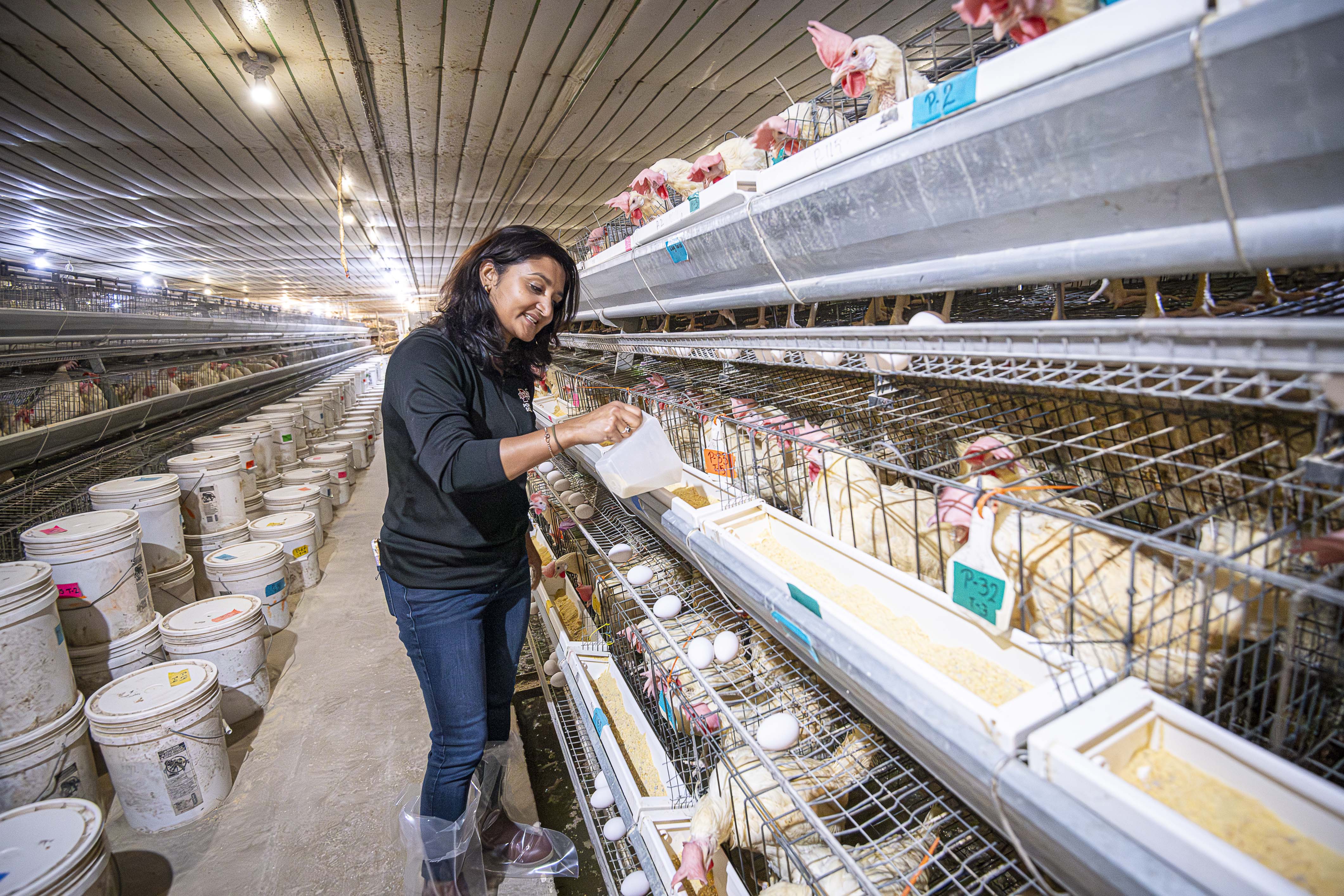
Dr. Pratima Adhikari tests the Mill formulation on laying hens at the MAFES H. H. Leveck Animal Research Center. (Photo by David Ammon)
Behind the Science

Kelley Wamsley
Professor
Education: B.S., Animal and Nutritional Sciences; M.S., Animal and Food Science; Ph.D., Animal and Nutritional Sciences, West Virginia University
Years At MSU: 13
Focus: Nutritional consequences of feed manufacture, feed form impact on modern broilers, and practical application of feed additives and alternative feed ingredients
Passion At Work: Our work can be utilized by poultry producers almost immediately, directly impacting the way poultry is produced and, ultimately, helping to feed the world's growing population.

Pratima Acharya Adhikari
Associate Professor
Education: B.S., D.V.M., Veterinary Science and Animal Husbandry, Tribhuvan University; M.S., Animal Nutrition, University of Manitoba; Ph.D., Poultry Science, University of Georgia
Years At MSU: 8
Focus: Nutrition, gut health, management, Salmonella and E. coli disease challenge models
Passion At Work: Understanding, serving, and helping the U.S. egg industry and producers through research based on production and nutrition work and making it applicable to large commercial farms and the poultry industry.

Tim Boltz
Assistant Professor
Education: B.S., Animal Science, Colorado State University; M.S., Nutritional and Food Sciences; Ph.D., Animal and Food Sciences, West Virginia University
Years At MSU: 3.5
Focus: Poultry nutrition and feed hygiene, and how these can optimize poultry production
Passion At Work: I am passionate about making poultry feed safer and more effective by bridging nutrition, microbiology, and feed manufacturing, all while also inspiring and training the next generation of poultry scientists.