
Billion-Dollar Bacteria Breakthrough
Developing a rapid test for detecting a widespread poultry disease
By: Meg Henderson
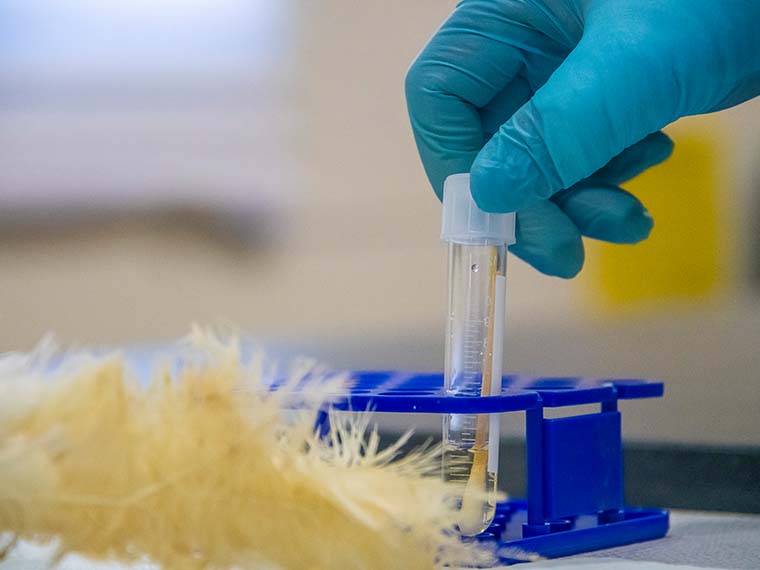
Scientists test a sample for C. perfringens at the MAFES H. H. Leveck Animal Research Center. (Photo by Dominique Belcher)
Chronic illnesses are often called "invisible illnesses" because the symptoms don't appear until the disease has progressed far enough to cause considerable damage. For poultry, a severe intestinal disease called necrotic enteritis, or NE, can occur in an overt (clinical) or more insidious (subclinical) form. The subclinical form is often invisible, but its impact on production is quite profound. Activated by the bacterium C. perfringens, NE causes inflammation and necrosis, or death of cells and tissue, in the intestinal lining. The global poultry industry loses an estimated $6 billion annually from the disease, mostly in birds with subclinical cases.
Poultry contract the disease when multiple factors disrupt the gut lining. Common contributors include prior gut damage and diets high in wheat or fishmeal. The bacteria then feed on proteins that leak through the compromised gut.
To shine a light on the problem at its source, scientists in the Mississippi Agricultural and Forestry Experiment Station, or MAFES, have developed a novel rapid test for C. perfringens. Today, the most common test for these bacteria is a polymerase chain reaction (PCR). While effective, it is expensive and requires specialized lab equipment and experienced personnel to administer.
Dr. Li Zhang, an assistant professor of poultry science and Mississippi State University MAFES scientist, identified the need for a field-deployable test to prevent and manage NE outbreaks. With his former graduate student Deepa Chaudhary, now a doctoral candidate at Auburn University's School of Veterinary Medicine, Zhang tested a loop-mediated isothermal amplification (LAMP) assay, along with various DNA extraction methods, to find a combination of diagnostics that would yield accurate results using minimal equipment and simple methodology.
"We got the idea from the rapid test kits distributed during the COVID pandemic. They were using a LAMP assay to test for the virus, so we thought, why not try to adapt that concept to make a more user-friendly test for NE?" Zhang said.
Chaudhary explained that while the methods and equipment are different, both PCR and LAMP achieve results by amplifying DNA. Sometimes called "molecular photocopying," this method produces identical copies of small DNA segments in quantities sufficient for analysis.
"The main difference is that PCR uses sophisticated laboratory equipment to test the sample and a highly trained expert to interpret the results. In comparison, a LAMP assay uses just a single tube, some reaction agents, and a heating block, and you don't need special expertise to administer it," she said.
Besides the ease of conducting the test outside a laboratory, the results are as easy to interpret as a home COVID test: a change in color on the test strip indicates a positive result. And it saves time, with test results ready in 30 minutes, instead of up to an hour and a half.
To prepare the bacterial sample for the LAMP assay, it is first necessary to extract the DNA. Zhang and Chaudhary identified the need to simplify this step as well to streamline the entire process. They tested four methods: Spin Column, Magnetic Beads, Dipstick, and HotSHOT, the latter being chosen for producing the highest DNA yield while keeping time to five minutes, cost at $0.09 per sample, and equipment—a single tube—at a minimum.
For the HotSHOT method, bacterial cells are placed in a test tube with sodium hydroxide, or lye, and heated to 95 degrees Celsius. The reaction releases the DNA, making it available to amplify with the LAMP assay.
"Even though the DNA from HotSHOT is not as pure as it would be using the spin column method, it is good enough to work with LAMP and doesn't need expensive equipment that is not practical for field testing," Zhang said.
The ultimate goal of this research is to develop a kit that veterinarians or service technicians can use on-site. With minimal training, they can collect samples, run tests, and deliver results in a matter of minutes, not hours or days.
"We want this method to be easy to train people to use," Chaudhary said. "That's why our test has one tube, minimal pipetting, and results that are visible to the naked eye."
While this study took the important first step in managing NE across the industry, Zhang will continue working on rapid result testing for pathogens and advancing practical, preventative solutions.
"We've identified a way to detect NE, but our next goal is to quantify it so we can determine how severe the problem is," he said. "We know that this is an industry-wide problem from the economic impacts, but the more we can test, the better we can understand the disease at the farm level."
In addition to MAFES, scientists received funding from the USDA National Institute of Food and Agriculture and the USDA Agricultural Research Service.
We got the idea from the rapid test kits distributed during the COVID pandemic. They were using a LAMP assay to test for the virus, so we thought, why not try to adapt that concept to make a more user-friendly test for NE?
Dr. Li Zhang
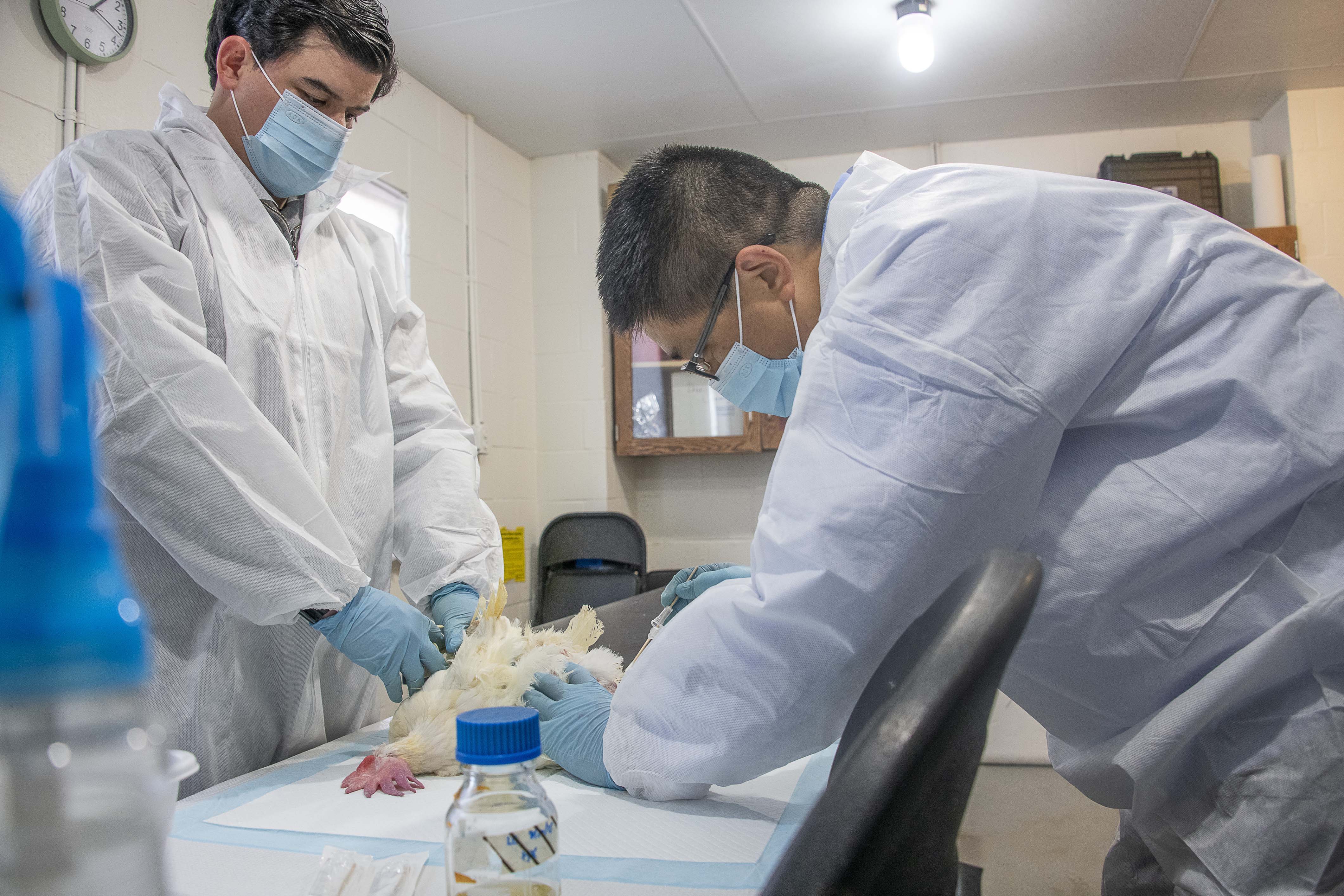
Scientists extract a sample from a sedated chicken. (Photo by Dominique Belcher)
Behind the Science

Li Zhang
Assistant Professor
Education: B.S., M.S., Food Science, Northeast Agricultural University, China; Ph.D., Nutrition, Mississippi State University
Years At MSU: 12
Focus: Agricultural microbiomes, animal health, and food safety
Passion At Work: The cycle of teaching, learning, and innovating is what drives me every day.