
The Power of Cottonseed
Turning a Mississippi crop into a new defense against parasites in goats
By: Kaitlyn Church
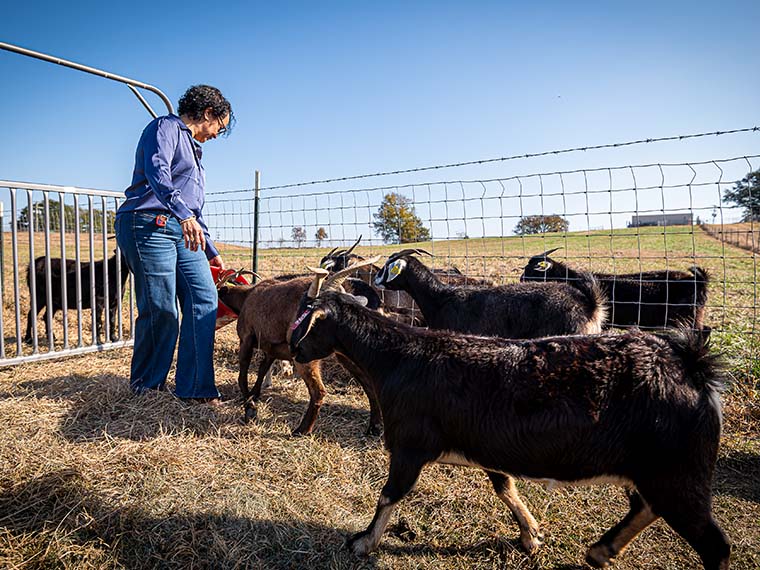
Dr. Leyla Rios de Alvarez inspects goats at the MAFES H. H. Leveck Animal Research Center (Photo by David Ammon)
For Mississippi's small-ruminant producers, one of the biggest challenges is not only keeping their herds fed but also keeping them healthy. Parasites are the biggest threat, affecting animal welfare and farm profitability. Now, researchers in the Mississippi Agricultural and Forestry Experiment Station, or MAFES, are turning to a common southern crop for help: cotton.
A new study led by Dr. Leyla Rios de Alvarez, assistant professor in the Department of Animal and Dairy Sciences and MAFES scientist, explores whether cottonseed, a byproduct of cotton production and a common livestock feed, could help manage parasite infections in goats. The project, Effect of Cottonseed as a Source of Gossypol on Parasite Burden, Reproduction and Gastrointestinal Microbiome of Meat Goats, brings together specialists in nutrition, physiology, and microbiology to understand how diet affects the health of animals threatened by parasites.
"Cotton is an important commodity for Mississippi and the Southeast, and cottonseed is a popular and affordable supplement for livestock," Rios said. "Cottonseed contains a compound called gossypol, which is a type of polyphenol. Other groups of polyphenols, such as tannins, have been widely researched as a natural way to control gastrointestinal parasites in small ruminants. We wanted to see if cottonseed could have similar benefits."
Parasites, particularly the barber pole worm (Haemonchus contortus), remain one of the most significant health issues for small ruminants worldwide. This parasite causes anemia, reduces weight gain, and can be fatal in severe cases. For goat and sheep producers, infestations lead to economic losses through decreased performance and expensive treatment costs.
"Gastrointestinal parasites are the main health issue that any sheep or goat farmer will face while raising these species," Rios said. "The barber pole worm feeds on the host's blood, causing severe anemia, and if not controlled in time, will lead to death. It is a global problem that impacts animal welfare and farm efficiency."
Resistance of the parasite population to commercial dewormers has increased, making non-chemical control methods more important than ever. Rios and her team saw an opportunity to explore a nutritional strategy that could reduce the need for chemical treatment. To test this idea, researchers conducted a controlled feeding trial with 40 female goats after weaning. Half of the goats were infected with barber pole worm larvae. Within each group, some goats received cottonseed supplements, while others were fed a similar commercial feed without cottonseed. The team monitored weight gain, body condition, FAMACHA© (anemia levels), and fecal parasite counts to evaluate the effects of cottonseed on overall health. They also studied liver blood flow, rumen microbial populations, and organ function to determine whether cottonseed could influence physiological resilience.
"Cottonseed has high levels of fat and protein, making it nutritionally appealing for livestock," Rios said. "It is also much more affordable than many commercial feeds, around three hundred dollars per ton in Mississippi compared to nearly double that for a commercial feed with similar nutritional value."
Rios' team, all MAFES scientists in the Mississippi State University Department of Animal and Dairy Sciences, assisted in the research. Dr. Caleb Lemley evaluated how diet and infection affected liver blood flow using Doppler ultrasonography, while Dr. Peixin Fan examined changes in the rumen microbiome. The results revealed some unexpected physiological changes.
"Interestingly, liver blood flow relative to liver weight was increased in the animals that were fed cottonseed," Lemley said. "That indicates an increase in liver metabolism, which could be further studied since changes in liver metabolism could affect other production variables, such as reproduction and growth."
The work conducted by Fan supported those observations by showing how cottonseed may influence microbial activity in the rumen—the first compartment of the stomach of a ruminant, that partially digests food with the aid of bacteria—even under parasitic stress.
"Parasite infection decreases microbial richness or the volume of good bacteria in the rumen," Fan said. "Cottonseed supplementation partially restored that balance, increasing bacteria associated with lipid metabolism and butyrate production. Butyrate is a short-chain fatty acid known for its anti-inflammatory and gut-protective properties, while lipid metabolism is key for providing energy and supporting overall animal health. Therefore, restoring these microbes can help improve nutrient use and growth."
The findings suggest cottonseed could help maintain digestive health and resilience in goats facing parasite challenges. Fan noted that future work will explore whether the enrichment of butyrate-producing bacteria mediates anti-inflammatory and metabolic resilience under parasitic pressure, and whether rumen microbial degradation of gossypol can limit cottonseed's antiparasitic properties.
Although the study did not find a significant reduction in parasite load at the tested level of cottonseed, it revealed notable physiological and microbial changes, offering new insight into how diet influences organ function and microbial balance.
"We were able to look at the goats' health from multiple perspectives: parasite load, organ function, and microbiome activity, thanks to collaboration across disciplines," Rios said. "It was a very intense and demanding project that helped me build an amazing team of students and collaborators."
Despite its challenges, the study broke new ground.
"All results were novel since cottonseed has not been studied before in goats for its possible anti-parasite properties or for its effect on the microbiome or liver function," Rios said. "Different levels of cottonseed need to be evaluated to check for possible effects, and it would also be interesting to test cottonseed or cottonseed extracts in vitro to determine effective dosages."
Rios hopes to continue exploring those possibilities through future laboratory and farm trials.
Although the research on cottonseed is in its early stages, its implications reach far beyond the laboratory. If future studies confirm that cottonseed, or specific compounds within it, can help manage parasite burdens, it could offer a cost-effective and locally sourced supplement that strengthens goat health and reduces chemical use.
"If, after more studies, an anti-parasitic effect is found, it could provide a natural alternative for reducing the use of commercial dewormers," Rios said. "Most of these dewormers have high resistance worldwide, creating a need for natural solutions."
For small ruminant producers in Mississippi, that potential is significant.
"It would be a great contribution to small ruminant farmers to reduce the costs of supplementation and increase the productivity of their animals," Rios said.
Beyond the scientific findings, she emphasized the importance of producer collaboration in shaping MSU research priorities.
"This research comes from exchanging experiences with Mississippi sheep and goat farmers who already use cottonseed as a supplement and are looking to have more answers on how to take care of their animals in an efficient way," Rios said. "Scientists in MAFES and the MSU Extension Service are interested in farmers' needs. We want to hear from them, their worries, and their ideas."
As MAFES scientists continue to investigate how local crops like cotton can support livestock health, the project supports the university's land-grant mission in action, bridging basic research with practical solutions. By combining physiology, microbiology, and on-farm insight, the team is helping producers find innovative, sustainable tools to care for their herds, one crop at a time.
This research is funded by the Mississippi Agricultural and Forestry Experiment Station.
Cottonseed has high levels of fat and protein, making it nutritionally appealing for livestock. It is also much more affordable than many commercial feeds, around three hundred dollars per ton in Mississippi compared to nearly double that for a commercial feed with similar nutritional value.
Dr. Leyla Rios de Alvarez
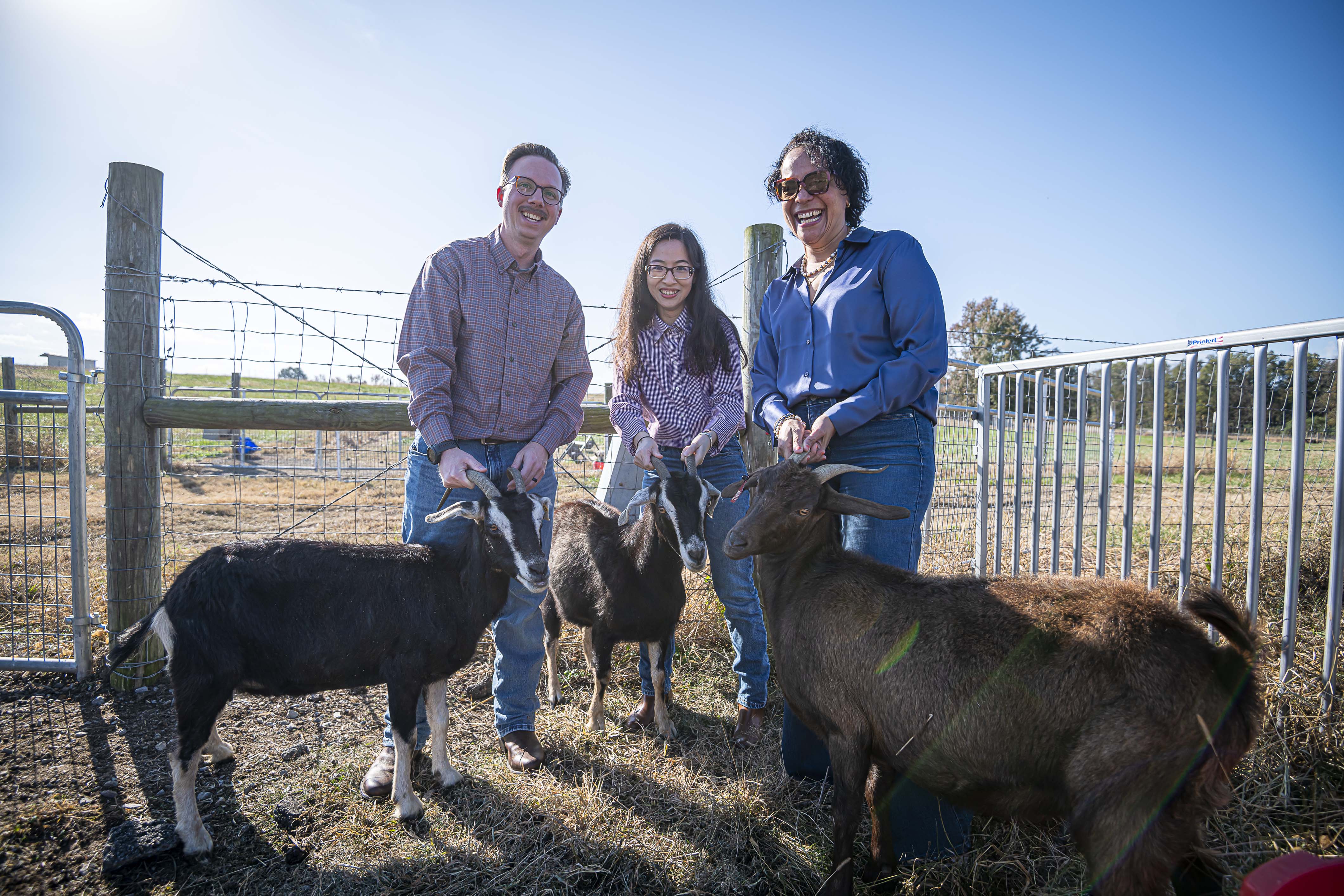
MAFES scientists, Dr. Caleb Lemley, Dr. Peixin Fan, and Dr. Leyla Rios de Alvarez with goats at the MAFES H. H. Leveck Animal Research Center. (Photo by David Ammon)
Behind the Science

Caleb Lemley
Professor
Education: B.S., Biochemistry; M.S., Ph.D., Reproductive Physiology, West Virginia University
Years At MSU: 13
Focus: How environmental factors shape reproductive endocrinology and developmental programming in livestock
Passion At Work: I am passionate about advancing animal science through collaborative research, integrative scientific inquiry, and dedicated mentorship in support of the land-grant mission.

Leyla Rios de Alvarez
Assistant Professor
Education: B.S., Agronomist/Animal Science; M.S., Animal Production/Ruminant Nutrition, Universidad Central de Venezuela; Ph.D., GeoSciences, University of Edinburgh
Years At MSU: 5
Focus: Sustainable parasite control in small ruminants
Passion At Work: Small ruminant research, extension, and teaching are my passions.

Peixin Fan
Assistant Professor
Education: B.S., Animal Science; M.S., Animal Science/Swine Nutrition, China Agricultural University; Ph.D., Animal Science/Animal Microbiome, University of Florida
Years At MSU: 3
Focus: Host-microbe interactions in livestock, with the aim to identify critical microbes and their functional genes in regulating animal growth, health, and behaviors to improve animal welfare and contribute to agricultural sustainability
Passion At Work: Advancing research on animal-microbe interactions, integrating discoveries into education, and applying them to enhance livestock health and productivity.